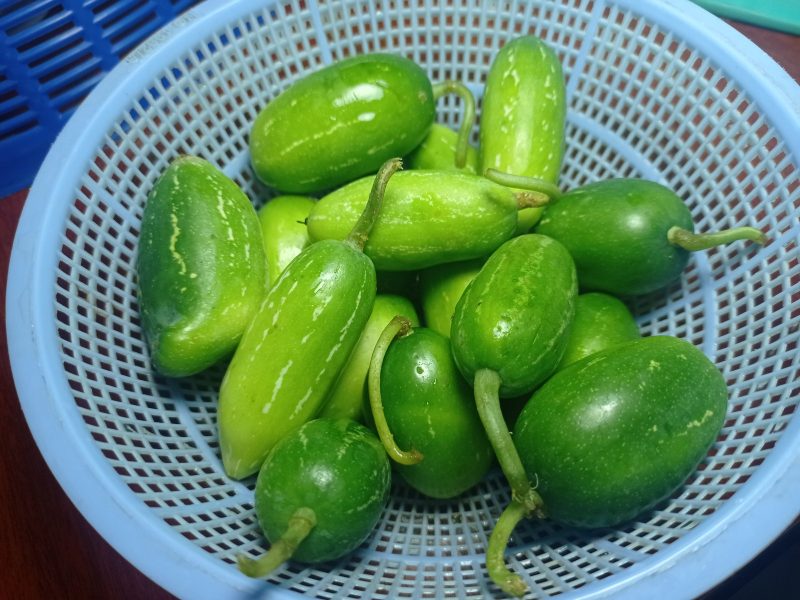
Kowakka (Coccinia grandis) is the slender, ivy-leaved creeper that scrambles over garden fences all over Sri Lanka, hung with small green fruits striped in white like miniature cucumbers. Its tender leaves are shredded into kowakka kola mallum and its fruits go into curries, and many eat it deliberately for its old reputation for keeping blood sugar down.
Botanical and Cultural Background
Ivy gourd is a perennial climbing vine of the gourd family with lobed, ivy-like leaves, coiled tendrils and white, star-shaped flowers; male and female flowers grow on separate plants. The fruits are 3-6 cm long, green with pale stripes, and turn scarlet when ripe. It grows wild and in home gardens across the low country and is also called ken in some areas. Its Sanskrit name is bimbi, and in Ayurveda and Deshiya Chikitsa it is best known as a food-medicine for madhumeha (diabetes).
Traditional Uses in Sri Lankan Medicine
- Blood sugar (madhumeha) — leaves eaten as mallum several times a week, or raw leaves mixed with scraped coconut.
- Everyday vegetable for diabetics — tender green fruits curried or tempered as a light, low-starch vegetable.
- Small skin sores and itching — crushed fresh leaves applied as a paste to small boils, rashes and insect bites.
What the Research Shows
Some of the key research was done in Sri Lanka. In Matara, 122 healthy volunteers ate 20 g of raw kowakka leaves with scraped coconut, or a look-alike placebo of erabadu leaves, before a glucose drink; the rise in blood sugar was about 20 mg/dL lower at one hour and 11 mg/dL lower at two hours with kowakka. This was a one-off test in people without diabetes.
Two placebo-controlled trials used capsules. In Bangalore, 60 people with newly found, mild type 2 diabetes took 1 g of extract daily for 90 days; fasting and after-meal sugar fell by about 16% and 18%, and HbA1c also fell, compared with placebo. In Galle, 158 newly diagnosed patients took a 500 mg kowakka capsule or placebo daily for three months; HbA1c improved by about 0.65 percentage points versus 0.08 on placebo, triglycerides also improved, and liver, kidney and blood tests stayed normal.
A 2024 meta-analysis of seven trials (595 people, 1-90 days) found lower fasting and after-meal sugar and triglycerides but no significant change in HbA1c, and the authors said long-term benefits and safety are unknown. The effect is modest, the trials were small and short, and none tested everyday kowakka mallum. It can be part of a diabetic diet; it does not replace medicine.
Evidence updated November 2026.
How Kowakka Is Prepared
Kowakka kola mallum: wash a packed cup of tender leaves and shoot tips, shred finely, and toss in a dry pan for 1-2 minutes with 2-3 tablespoons of scraped coconut, a little red onion, green chilli, a pinch of turmeric and salt. Add lime off the heat and eat with rice, two or three times a week.
Fruit curry: slice 10-15 green fruits lengthwise and cook with onion, curry leaves and a little thin coconut milk, or temper them with mustard seeds and chilli.
Leaf paste: crush a few fresh leaves, apply to a small itchy patch and wash off after 20-30 minutes.
Safety and Precautions
- Diabetes medicines — kowakka may add to the effect of tablets or insulin. Check your sugar more often when you start, watch for low-sugar signs (sweating, shaking, confusion), and never change medicine without your doctor.
- Capsules and extracts — trials of up to three months reported few side effects, but long-term safety is unknown; use only registered products and tell your doctor.
- Pregnancy, breastfeeding and children — normal food amounts are fine; avoid capsules and extracts, which have not been studied in these groups.
- See a doctor — for very high or low sugar readings, wounds that will not heal, or any infected skin sore.

Comments (0)
Leave a Comment