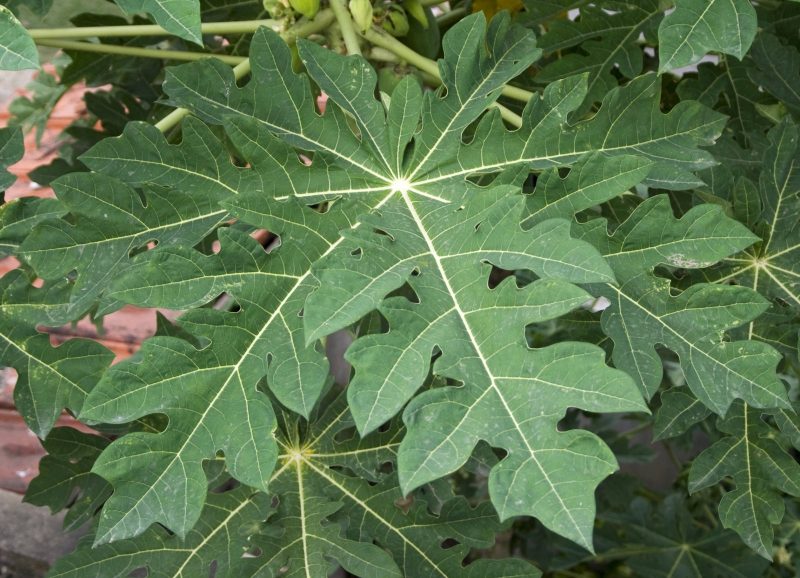
Almost every Sri Lankan home garden has a gaslabu, or papol, tree (Carica papaya): a tall, unbranched stem topped with an umbrella of huge, deeply lobed leaves and a ring of green fruit. Every dengue season, its bitter leaves are crushed and squeezed in kitchens across the island in the hope of lifting a falling platelet count, while the ripe orange fruit remains the everyday remedy for a sluggish stomach.
Botanical and Cultural Background
Papaya is a fast-growing, short-lived, soft-stemmed plant of the family Caricaceae, usually 3–8 m tall. Its large leaves, cut into seven or more lobes, sit on long hollow stalks, and every green part bleeds a white, milky latex. Native to tropical America, it reached South Asia with European traders centuries ago and now grows all over Sri Lanka. Gaslabu means “tree gourd”. The latex is rich in papain, a protein-digesting enzyme long used to tenderise meat.
Traditional Uses in Sri Lankan Medicine
- Dengue fever — fresh leaf juice in small doses, a common household practice in recent years.
- Constipation and indigestion — ripe fruit eaten in the morning or after a heavy meal.
- Intestinal worms — dried, crushed seeds mixed with honey.
What the Research Shows
A 2019 systematic review by Sri Lankan researchers found nine dengue studies, mostly small and from India. Seven reported higher platelet counts with papaya leaf extract; pooled data suggested a modest platelet rise and a hospital stay about two days shorter, but the evidence was low quality. There was no evidence on plasma leakage (fluid leaking from blood vessels, which drives severe dengue) or deaths, and the authors judged the evidence insufficient. An earlier review of four randomised trials (439 patients) found a similar platelet rise of unclear clinical value, with inadequate safety data. In plain terms: papaya leaf extract raised platelet counts in some small trials, but it has not been shown to reduce dengue complications or deaths.
For digestion, a placebo-controlled trial of a commercial papaya preparation (20 ml a day for 40 days) eased constipation and bloating, but the benefit faded once it was stopped. A pilot trial in 60 Nigerian children found that air-dried seeds mixed with honey cleared intestinal parasites in 77%, against 17% with honey alone; it was not compared with standard deworming tablets. In a rat study, ripe papaya caused no harm in pregnancy, but crude latex, plentiful in unripe fruit, made the womb contract strongly.
Evidence updated November 2026.
How Gaslabu Is Prepared
- Leaf juice (dengue) — wash one or two fresh, fully grown green leaves, remove the stalks and thick veins, grind with a few spoons of water and squeeze through a clean cloth. Families usually give about two tablespoons once or twice a day for a few days, only with the knowledge of the treating doctor.
- Ripe fruit — a cup (about 150 g) of ripe papaya in the morning for constipation.
- Seeds — air-dry the black seeds, crush half a teaspoon and mix with a teaspoon of honey; adults take it once a day for a few days.
Safety and Precautions
Dengue can become dangerous quickly, often just as the fever settles. Go to hospital at once if there is severe abdominal pain, repeated vomiting, bleeding from the gums or nose, black stools, drowsiness or restlessness, cold hands and feet, or very little urine. Leaf juice must never delay admission or replace hospital care. The juice is very bitter and can cause nausea or vomiting; stop it if it does, since vomiting makes it harder to keep up fluids.
In pregnancy, ordinary amounts of ripe papaya appear safe, but avoid unripe or half-ripe fruit, latex, leaf juice and seed preparations. The latex irritates skin and eyes, and people allergic to rubber latex may react to papaya. If you take warfarin or another blood thinner, ask your doctor before using papaya leaf. Children with dengue need medical care; give leaf juice only if their doctor agrees.

Comments (0)
Leave a Comment