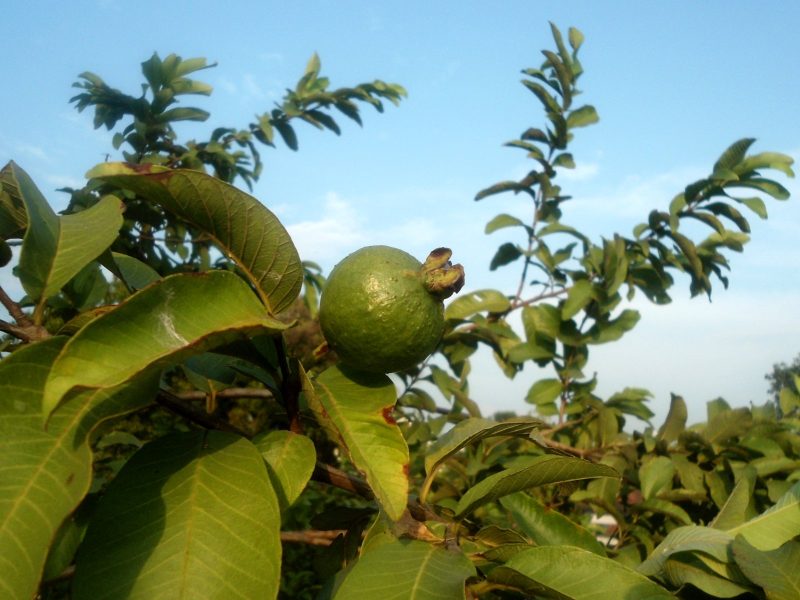
A pera tree grows in almost every Sri Lankan home garden, and when someone has loose motions, a grandmother will often pluck a handful of tender pera dalu and boil them. The same young leaves are chewed for toothache or used as a rinse for sore gums, and guava leaf tea is now sold for blood sugar.
Botanical and Cultural Background
Psidium guajava is a small tree of the myrtle family (Myrtaceae), native to tropical America and brought to Sri Lanka centuries ago; the name pera is thought to come from Portuguese. It has smooth, peeling, copper-brown bark and stiff oval leaves with clear parallel veins that smell aromatic when crushed. It grows in both wet and dry zones. The tender leaf buds are the part used in home medicine; it is a household remedy rather than a classical Ayurvedic herb.
Traditional Uses in Sri Lankan Medicine
- Diarrhoea and dysentery — a decoction of tender leaves, sipped through the day.
- Toothache, swollen gums and mouth ulcers — tender leaves chewed, or a warm decoction held in the mouth or gargled.
- Wounds and itchy skin — the decoction used as a wash.
- Blood sugar — guava leaf tea with meals, a newer use.
What the Research Shows
Diarrhoea: In a randomised, double-blind trial in 50 Mexican adults with acute diarrhoea, capsules of a standardised guava leaf product (500 mg every 8 hours for 3 days) shortened the duration of abdominal pain. Laboratory and animal studies show guava leaf extracts relax gut spasm and act against some diarrhoea-causing microbes. Guava leaf has not been shown to replace oral rehydration salts.
Blood sugar: Most human data concern a guava leaf tea that is approved in Japan as a health food. In studies reviewed by researchers from the company that makes it, one cup with a rice meal cut the after-meal rise in blood sugar by about 20% in 19 adults; in 20 people with type 2 diabetes the effect was smaller than the drug voglibose. In 8–12 week studies of 15–23 people, mostly without a comparison group, fasting sugar barely changed and HbA1c fell slightly only in some subgroups. No hypoglycaemia was reported. The evidence is promising but weak.
Gums: In a randomised trial of 60 adults with gum inflammation, a 0.15% guava leaf mouthrinse used for 30 days reduced plaque and gum inflammation more than a water placebo, as did chlorhexidine. No trial has tested guava leaf for toothache itself.
Evidence updated November 2026.
How Pera Kola Is Prepared
- Diarrhoea decoction — wash 10–15 tender leaves, boil in two cups of water until one cup remains. Adults drink half a cup two or three times a day, alongside oral rehydration salts.
- Mouth rinse — boil 5–6 leaves in a cup of water for 5 minutes, add a pinch of salt and use warm as a rinse or gargle 2–3 times a day. For toothache, one or two tender leaves can be chewed and held by the sore tooth.
- Leaf tea — steep 3–4 fresh or dried leaves in a cup of hot water for 5–10 minutes and drink with a meal.
Safety and Precautions
Normal amounts are generally well tolerated, but the astringent leaves can cause constipation.
- Diarrhoea: fluids come first — use Jeewani or other oral rehydration salts. Do not give leaf decoctions to babies. See a doctor for infants and young children, blood in the stool, high fever, repeated vomiting, signs of dehydration (little urine, sunken eyes, drowsiness) or diarrhoea lasting more than two days.
- Diabetes: do not replace prescribed treatment; check your sugar if you add guava leaf tea to insulin or tablets, and tell your doctor.
- Pregnancy and breastfeeding: there are no safety studies; avoid concentrated extracts and capsules and keep the tea occasional.
- Toothache usually means decay or infection: see a dentist, urgently if your face swells or you have fever.

Comments (0)
Leave a Comment