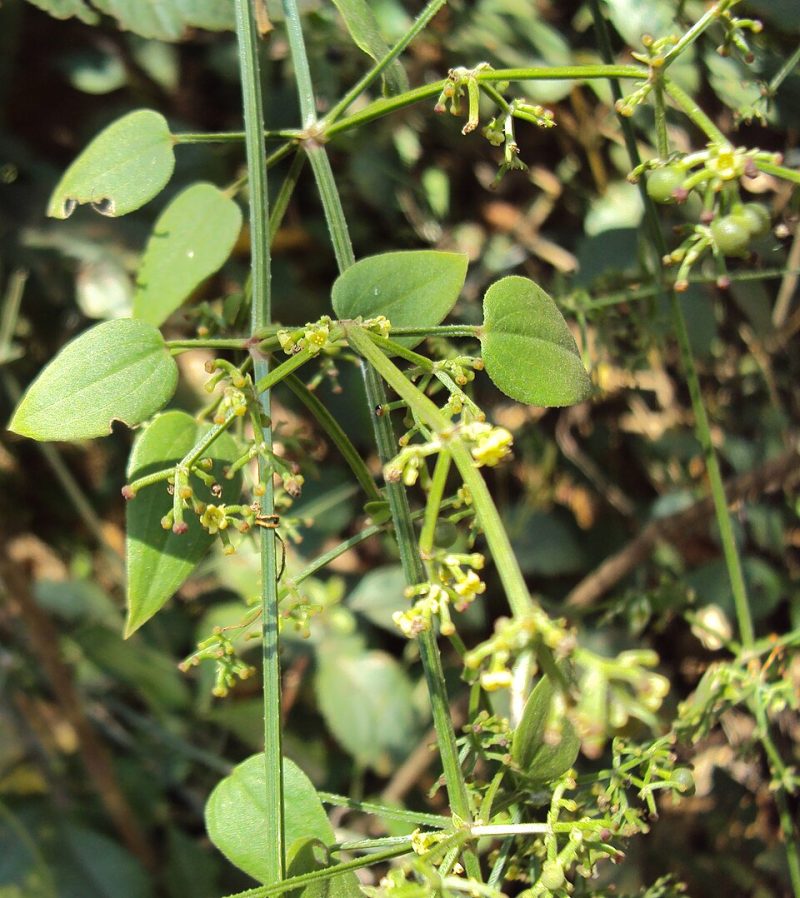
Welmadata (Rubia cordifolia) has coloured cloth and treated skin for as long as either has been recorded. Its root yields a deep red dye, and the same red anthraquinones that stain fabric are the reason Ayurveda classes it as raktashodhaka — a purifier of the blood — and reaches for it in skin disease.
Botanical and Cultural Background
Welmadata is a scrambling perennial climber of the Rubiaceae family — the coffee family — with square, rough stems bearing tiny recurved prickles and leaves in whorls of four. The medicinal part is the root, red-brown outside and red within.
Its dual identity as dye and medicine is not coincidental: colour and pharmacology come from the same class of compounds. It appears in classical formulations including Mahamanjishtadi preparations and traditional healing oils.
Traditional Uses in Sri Lankan Medicine
Skin conditions
Its principal use — for acne, eczema, rashes and pigmentation, both taken internally and applied to the skin.
"Blood purification"
Welmadata is a classical raktashodhaka. As with iramusu, it is worth being precise: in traditional theory this means clearing heat and impurity, with clearer skin as the visible sign. It does not mean the root filters blood — kidneys and liver do that.
Complexion
Powder mixed with honey or sandalwood is applied traditionally as a face pack.
Joint complaints
It is a component of traditional massage oils used for aching joints and muscles.
What the Research Shows
Research on Rubia cordifolia has identified anthraquinones — including purpurin, munjistin and alizarin-type compounds — along with cyclic hexapeptides, and has examined antioxidant, anti-inflammatory and antimicrobial activity, largely in laboratory and animal models.
Human clinical evidence is thin. The claims that welmadata treats psoriasis or vitiligo are not supported: both are complex conditions with established medical treatments, and vitiligo in particular has no traditional or herbal cure. The suggestion that it heals diabetic ulcers should be firmly set aside — see below.
There is also a genuine safety question in this genus. Lucidin, an anthraquinone found in Rubia species, is genotoxic and mutagenic, and concern over it led German authorities to withdraw madder root (Rubia tinctorum) preparations from the market. Rubia cordifolia is a different species and the data are less complete, but the family resemblance is not something to wave away — it argues against casual long-term internal use.
How Welmadata Is Prepared
Decoction: Dried root boiled in water and reduced.
Face pack: Root powder mixed with honey or sandalwood paste, applied externally.
In oils: A component of traditional massage oils.
Safety and Precautions
Do not treat a diabetic foot ulcer with welmadata or any home remedy. This deserves to be stated bluntly. Diabetic ulcers become infected easily, can reach bone, and are a leading cause of amputation — they need urgent, specialist wound care. Any non-healing wound in a person with diabetes is a medical emergency in slow motion, and time lost to home treatment is limb lost.
Given the genotoxicity concerns around Rubia anthraquinones, prolonged internal use is not advisable, and it should not be used internally during pregnancy or breastfeeding. Welmadata is harmless in one respect that alarms people: it can turn urine reddish. That is the dye, not blood — but if you are unsure whether discolouration is dye or blood, see a doctor rather than assume.
Persistent skin disease deserves a diagnosis. Psoriasis, chronic eczema and vitiligo have real treatments, and the years people spend on herbal self-treatment are years those treatments are not working for them.



Comments (0)
Leave a Comment