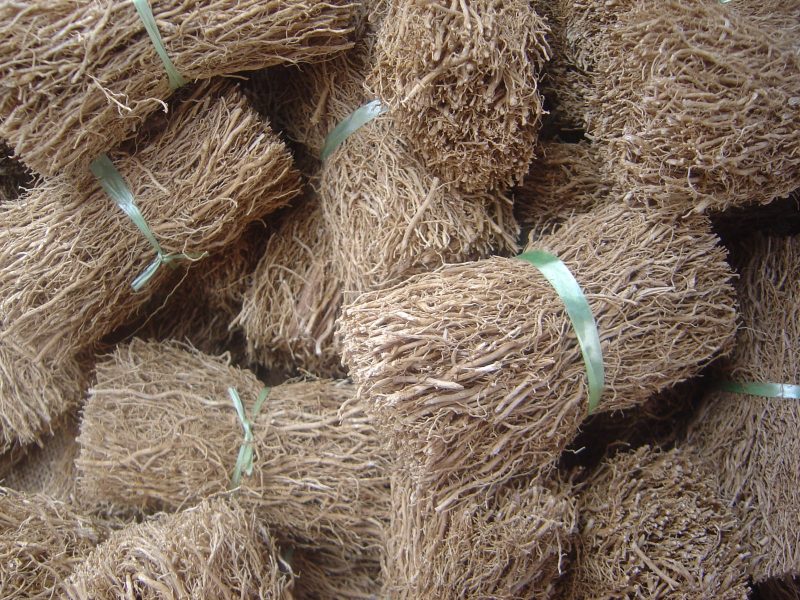
On hot afternoons in many Sri Lankan homes, a small bundle of pale, wiry roots is tied inside the clay water pot. That is sevendara, or vetiver, and it gives the water a faint, earthy, cooling fragrance. The roots are also woven into fans and mats and boiled into cooling drinks for fever.
Botanical and Cultural Background
Sevendara (Chrysopogon zizanioides, formerly Vetiveria zizanioides) is a tall, densely tufted grass of the family Poaceae, with stiff, narrow leaves about 1.5 m high. Its treasure is a mass of fine, spongy roots that grow straight down for metres and hold a fragrant oil. It grows on stream banks and marshy lowlands, and is also cultivated. In Sanskrit it is ushira, in Tamil vettiver and in Hindi khus. Ayurveda counts ushira among the cooling herbs, and it is recorded in Jayaweera’s survey of Ceylon’s medicinal plants. Because its roots bind soil, vetiver is planted as living hedges on slopes in many tropical countries.
Traditional Uses in Sri Lankan Medicine
- Body heat and thirst — a few roots kept in the drinking-water pot in hot weather.
- Fever with thirst — ushira is part of the classical shadanga paniya, water boiled with nut grass (kalanduru), sandalwood, dry ginger and other herbs.
- Burning urination — weak root decoctions for the burning that comes with heat.
- Prickly heat — a root paste, sometimes with sandalwood, applied to heat rash.
- Fragrance — fans and mats woven from the roots release their scent when sprinkled with water.
What the Research Shows
Sevendara has almost no clinical research as a medicine. Reviews in 2021 and 2025 summarise lab and animal studies suggesting anti-inflammatory, antioxidant, antimicrobial, pain-relieving and wound-healing effects, but both stress that the evidence is mainly preclinical and human trials are lacking. In one rat study, inhaled vetiver oil reduced anxiety-like behaviour much as diazepam did; whether it calms people is untested.
The strongest science on vetiver is environmental. A 1993 US National Research Council report showed how vetiver hedges slow runoff and trap soil on slopes, and a 2009 review found the grass tolerates drought, flooding and poor soils and takes up heavy metals such as lead and zinc, mostly into its roots. That is why roots for drinking water should come from clean ground.
Evidence updated November 2026.
How Sevendara Is Prepared
- Cooling drinking water — wash about 10 g of dried roots (a loose handful), tie with thread and put into two litres of boiled, cooled water in a clay pot. Drink through the day. Wash and sun-dry the bundle daily; replace it every few days, or sooner if it smells musty.
- Decoction for fever-time thirst — about 10 g of chopped root boiled in four cups of water down to two, strained and sipped through the day.
- Paste for heat rash — grind a little root with water, apply thinly and wash off when dry.
Safety and Precautions
Household use has a long record, but large medicinal doses are untested for safety.
- Clean source — buy roots from a reliable seller; never use roots from roadsides, drains or polluted land.
- Hygiene — use boiled water, cover the pot and change the roots often to avoid mould.
- Essential oil — do not swallow it; dilute before use on skin and keep it from children.
- Pregnancy, breastfeeding and young children — no safety research; keep to lightly flavoured water, not strong decoctions or the oil.
- Fever — a cooling drink does not treat the cause. Any fever lasting over two days, especially in dengue season, needs a doctor and a blood test; severe stomach pain, repeated vomiting, bleeding or drowsiness need hospital care at once.
- With kidney disease or regular medicines, ask your doctor before medicinal use.

Comments (0)
Leave a Comment