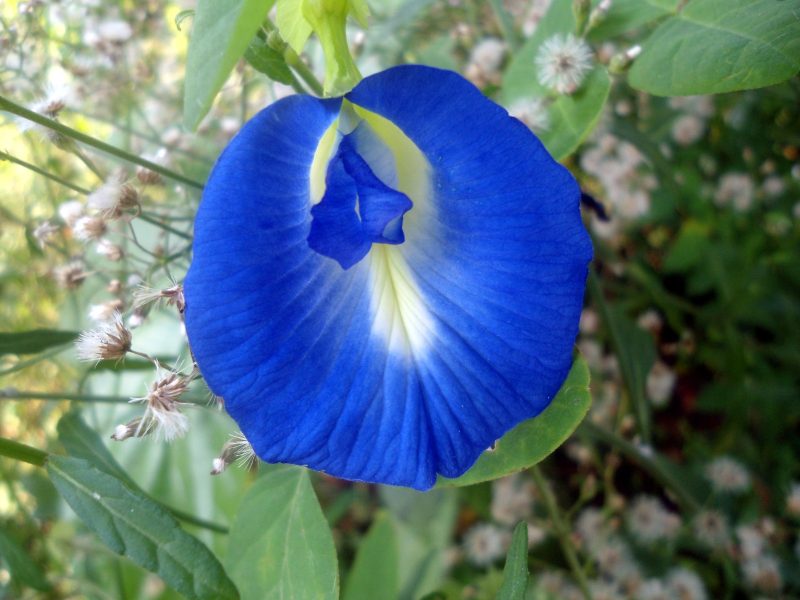
Nil katarolu (Clitoria ternatea) is the slender climber whose deep-blue flowers peep out of hedges and garden fences across Sri Lanka. Steeped in hot water the flowers make a startling blue tea, and a squeeze of lime turns it purple in seconds. In Ayurveda the plant, called aparajita, has long been valued as a tonic for the mind.
Botanical and Cultural Background
Butterfly pea is a perennial twining vine of the pea family (Fabaceae) with leaves of five to seven oval leaflets and single flowers 4-5 cm long, usually deep blue with a white-and-yellow centre. A white form, sudu katarolu, is often thought the more medicinal in Sri Lankan tradition. It grows easily in the low country. The Sanskrit name aparajita means ‘the unconquered’; in South India it is called shankhupushpam.
Traditional Uses in Sri Lankan Medicine
- Memory and concentration — root or whole-plant preparations, often with ghee or honey, as a medhya (brain) tonic; today the flower tea is popular with students.
- Calming and sleep — for anxiety, restlessness and stress, and in Ayurveda for fits.
- Natural blue colour — flowers boiled to colour rice, sweets and drinks.
- Clearing the bowels — the root is a traditional purgative, given only by physicians.
What the Research Shows
The brain-tonic reputation rests mainly on animal work. Reviews describe rat and mouse studies in which root and other extracts improved learning and memory and showed calming, anti-anxiety, antidepressant and anticonvulsant effects. The reviewers note that much of this is preliminary and that human evidence is minimal. No proper human trial has shown that the tea improves memory or exam results.
The only human data are on blood sugar, and very small. In a Thai randomised crossover study, 15 healthy young men drank 1 g or 2 g of flower extract in water, with or without 50 g of sugar. Taken with sugar, the extract blunted the rise in blood glucose and insulin at 30 minutes and raised antioxidant capacity in the blood; on its own it did not lower fasting sugar. This was a single drink in healthy people, not a test in diabetes.
The colour change is simple chemistry. The flowers are rich in anthocyanin pigments that are light blue near neutral, violet as acidity rises, red when strongly acidic and green in alkaline water. They are antioxidants in the test tube, but that does not prove a health benefit in the body.
Evidence updated November 2026.
How Nil Katarolu Is Prepared
Blue tea: pour a cup of just-boiled water over 5-7 fresh flowers or 1 teaspoon of dried flowers, cover for 5 minutes and strain. Add a squeeze of lime to turn it purple. Keep to one or two cups a day, with little or no sugar.
Drying flowers: pick open flowers in the morning, pull off the green base and dry in the shade until crisp.
Blue rice: boil a handful of flowers in the cooking water for a few minutes, strain, and cook rice in the blue water.
Root medicines are made by Ayurvedic and Deshiya physicians; do not make them at home.
Safety and Precautions
- Flower tea — appears well tolerated in normal amounts, but there are no long-term human safety studies.
- Roots and seeds — not for home use; the root is a traditional purgative and can cause cramps and diarrhoea.
- Pregnancy, breastfeeding and children — safety is not established; avoid regular tea and extracts. A little flower water as food colouring is unlikely to harm.
- Medicines — the extract can lower after-meal sugar, so people on diabetes medicine should check their readings. Lab studies report anti-platelet effects, so take care with aspirin, clopidogrel or warfarin and stop extracts two weeks before surgery.
- Memory problems — forgetfulness in older people needs a doctor's check, as some causes are treatable.

Comments (0)
Leave a Comment