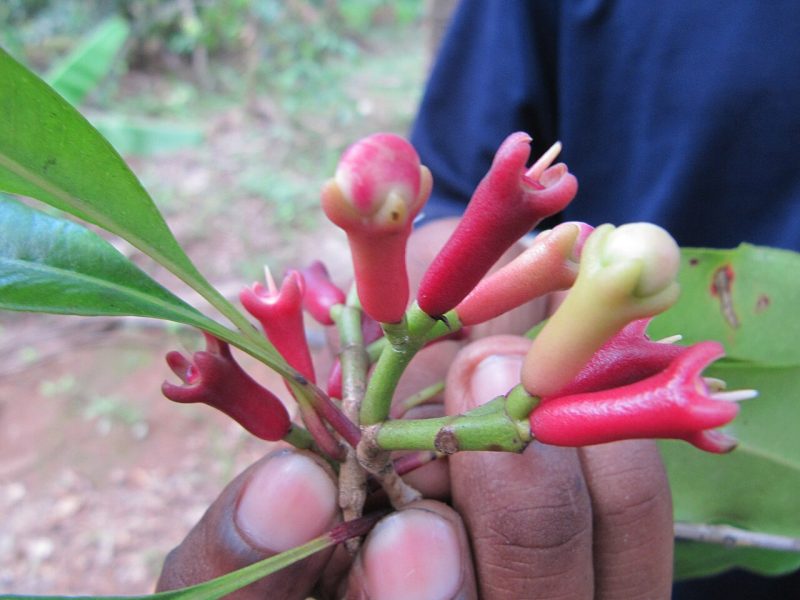
Karabu nati (Syzygium aromaticum) is one of the few household remedies whose active ingredient your dentist also keeps in a bottle. Eugenol — the compound responsible for the clove's smell and its numbing bite — has been used in dentistry for well over a century, in cements, dressings and temporary fillings. The kitchen spice and the dental surgery are not far apart.
Botanical and Cultural Background
Cloves are the dried unopened flower buds of a tropical evergreen tree of the Myrtaceae family, picked while still pink and dried to hard brown nails — the origin of the Sinhala name karabu nati and the English "clove", from the Latin clavus, a nail.
Clove was among the spices that drew European fleets to this part of the world. In Sri Lanka it is grown in the wet zone hills, and it sits in every kitchen as a curry-powder staple as much as a medicine.
Traditional Uses in Sri Lankan Medicine
Toothache and gums
The best-known use by a distance. A clove held against an aching tooth, or a trace of clove oil on cotton, numbs the area.
Digestion and nausea
A clove chewed after a heavy meal is a traditional carminative, used for bloating, gas and nausea.
Bad breath
Cloves are chewed as a breath freshener, an ancient practice recorded across many cultures.
Cough and sore throat
A clove chewed with a little rock salt is a household remedy for throat irritation.
What the Research Shows
Clove is chemically well characterised: eugenol makes up the great majority of clove essential oil. Eugenol has documented local anaesthetic and antibacterial activity, and this is not merely traditional — zinc oxide eugenol remains a standard dental material used for temporary fillings and dressings, and eugenol appears in dental products worldwide.
Research on clove has also examined antioxidant, antimicrobial and anti-inflammatory activity in laboratory models. Reviews describe it as one of the richest dietary sources of phenolic compounds.
The important limit is what numbing does and does not achieve. Eugenol relieves the pain of a toothache; it does not treat the decay, infection or abscess causing it. The pain is a signal, and silencing the signal while the cause continues is a poor trade.
How Karabu Nati Is Prepared
For toothache: A whole clove held gently against the tooth, or a tiny amount of clove oil on a small piece of cotton applied to the tooth itself — not rubbed over the gums.
For digestion: One clove chewed after a meal.
In tea: Two or three crushed cloves added to black tea.
Safety and Precautions
A toothache means see a dentist. Clove is a stopgap for the hours before an appointment, not a treatment. Dental decay does not reverse, and an untreated dental abscess can spread to the face, neck and bloodstream — occasionally with life-threatening consequences. If pain is severe, if there is facial swelling, fever or difficulty swallowing, that is urgent.
Clove oil is not clove. The whole spice used in cooking is one thing; concentrated clove oil is quite another and must be treated with respect. It should never be swallowed. Ingesting clove oil has caused serious liver injury, and the reported cases include young children who swallowed small amounts — keep it well out of their reach. Undiluted clove oil applied to gums or skin can cause chemical burns and tissue damage; when used on a tooth, keep it on the tooth.
Do not use clove oil on children's gums for teething. Because eugenol can affect blood clotting, tell your doctor if you take anticoagulants such as warfarin, and stop medicinal use of clove before surgery. Whole cloves as a culinary spice remain fine in pregnancy; concentrated oil or medicinal quantities are not advised without professional guidance.


_Alston_Family_COCHLOSPERMACEAE_(7).jpg)
_DC._var._vaginalis_(2790037054).jpg)
Comments (0)
Leave a Comment