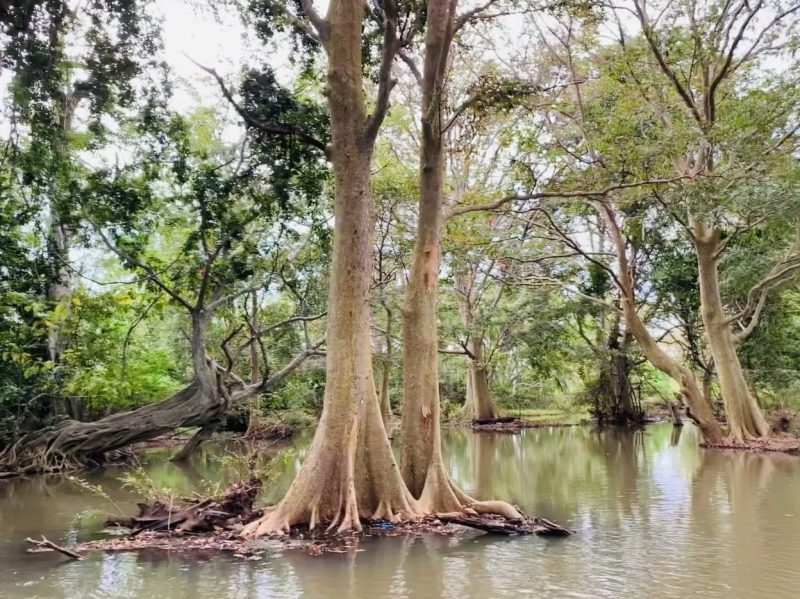
Kumbuk (Terminalia arjuna) is the great pale-trunked tree that leans over almost every river, canal and tank bund of the dry zone, its buttressed roots gripping the bank; the Kumbukkan Oya in the south-east is named after it. Its thick, flaking bark is the arjuna of Ayurveda, valued for centuries as a medicine for the heart.
Botanical and Cultural Background
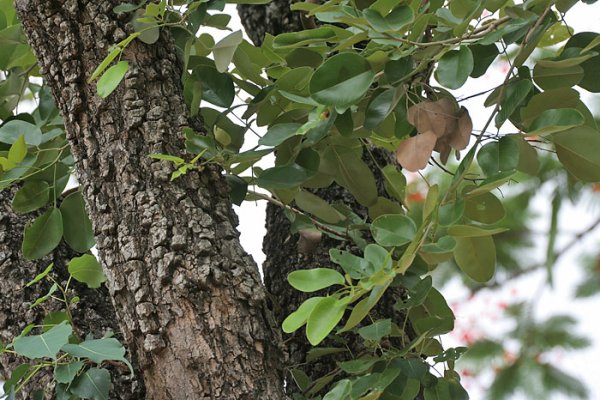
Kumbuk is a large tree of the family Combretaceae, a cousin of aralu and bulu. It grows 20–25 m tall, with a smooth grey-white to pinkish trunk that sheds its outer bark in thin flakes, showing reddish bark beneath. Its hard fruit has five wing-like ridges. It thrives along rivers and streams of the dry and intermediate zones. The Sanskrit name arjuna means bright or white, after the pale trunk. Jayaweera records it among the medicinal plants of Ceylon.
Traditional Uses in Sri Lankan Medicine
- Weak heart, palpitations and chest discomfort — bark powder boiled in milk (ksheerapaka) and taken daily as a heart tonic.
- High blood pressure and “fat in the blood” — bark decoction, often with other herbs, taken as a long-term remedy.
- Fractures and bruises — bark powder taken with milk and applied as a paste to help bones and bruised tissue heal.
- Diarrhoea, bleeding and wounds — the astringent decoction is drunk for loose motions and used to wash wounds and ulcers.
What the Research Shows
Laboratory and animal studies suggest that the bark, rich in triterpenoids, flavonoids and glycosides, has antioxidant, anti-ischaemic and cholesterol-lowering effects. For stable angina, a 2014 systematic review found only five small trials (147 patients), all at high risk of bias; none reported heart attacks or deaths, and pooled results showed no clear difference from the comparison treatments, so the authors called the evidence insufficient either way. For heart failure, a 2026 meta-analysis of nine studies (537 patients) found that arjuna reduced the mass of the heart’s main pumping chamber and raised “good” HDL cholesterol, but did not significantly improve pumping strength (ejection fraction), blood pressure, LDL or triglycerides.
In a long-term safety study, 35 people with coronary artery disease took 500 mg of bark extract three times a day with their usual medicines for up to almost five years; apart from gastritis and constipation, no notable side effects or blood-test changes were seen. No trial has yet shown that arjuna prevents heart attacks or saves lives, and its long-term safety is not fully established.
Evidence updated November 2026.
How Kumbuk Is Prepared
- Milk decoction (ksheerapaka) — one level teaspoon (3–5 g) of dried bark powder in one cup of milk and one cup of water, simmered gently until about one cup remains; strain and drink warm once a day.
- Water decoction — about 15 g of crushed dried bark (a piece the size of a matchbox) boiled in four cups of water until one cup remains; half in the morning, half at night.
If you collect bark yourself, take a strip from one side only; ringing the trunk kills the tree.
Safety and Precautions
Never stop or change heart, blood-pressure or cholesterol tablets without your doctor; kumbuk does not replace them. New, severe or lasting chest pain, especially with sweating or breathlessness, is an emergency: call 1990 (Suwa Seriya) or go to the nearest hospital at once.
Side effects reported in trials include constipation, gastritis, stomach discomfort, headache, body aches and dizziness. It may add to the effect of blood-pressure, cholesterol or blood-thinning medicines (such as aspirin or warfarin), so tell your doctor if you take it. There is no safety information for pregnancy or breastfeeding, so avoid it then, and do not give it to children unless prescribed. People with kidney or liver disease should get medical advice first.

Comments (0)
Leave a Comment