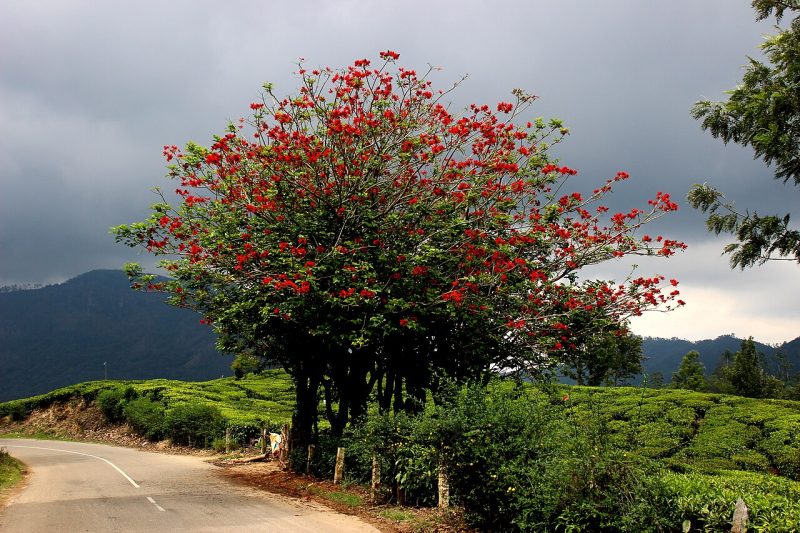
Erabadu (Erythrina variegata) keeps a calendar. Its scarlet flowers open as April arrives, alongside the erabadu-red of the Sinhala and Tamil New Year, and their appearance has told Sri Lankans that the season has turned for as long as anyone has been counting. The tree's medicine follows the same rhythm — its leaves are eaten at New Year, after the feasting.
Botanical and Cultural Background
Erabadu is a deciduous tree of the Fabaceae family, growing to fifteen metres or more, with a thorny trunk when young, three-part leaves and dense spikes of brilliant red flowers that appear when the tree is bare. It is planted as a living fence and shade tree, and it fixes nitrogen, which is why it turns up along field boundaries.
Its association with Aluth Avurudda is genuine and old — the flowering coincides with the New Year, and the leaf mallum eaten around that time is treated as a seasonal cleansing custom.
Traditional Uses in Sri Lankan Medicine
Intestinal worms
The traditional use the New Year custom is built around — young leaves eaten to clear worms.
Digestion
The leaves are mildly laxative, taken after heavy festival eating.
Joint pain
Leaves warmed and applied externally over swellings and sprains.
Sleep
The bark contains alkaloids with traditional sedative use.
What the Research Shows
Research on Erythrina variegata has identified erythrina alkaloids, along with flavonoids and isoflavonoids, and has examined antibacterial, anti-inflammatory and cytotoxic activity in laboratory models. The erythrina alkaloids are pharmacologically interesting — chemically related to compounds with curare-like neuromuscular blocking activity, which is precisely why the seeds are dangerous.
Human clinical evidence is absent, including for the deworming use.
That matters more than it might seem. Intestinal worms are not a vague traditional complaint — they are a measurable cause of anaemia, malnutrition and stunted growth in children, and they have a cheap, safe, extremely effective treatment. A single dose of mebendazole or albendazole clears most infections, costs very little, and is distributed free through Sri Lankan school deworming programmes. Erabadu mallum is a lovely custom; it is not a substitute for that.
How Erabadu Is Prepared
Erabadu mallum: Young leaves finely chopped and cooked with grated coconut, onion and spices. Always cooked, never raw.
Warm poultice: Fresh leaves warmed and bound over a swollen joint.
Safety and Precautions
The seeds are toxic and must never be eaten. This is the firm rule with erabadu. The bright red seeds contain erythrina alkaloids with curare-like neuromuscular activity, and they are attractive to children precisely because they are bright red and bean-like. If a child swallows erabadu seeds, go to hospital immediately.
If you are deworming a child, use the proper medicine. Mebendazole and albendazole are safe, cheap and highly effective, and are given free through school programmes in Sri Lanka. Enjoy the erabadu mallum as the custom it is, and deworm the child properly as well — the two are not in competition, but only one of them works.
Cook the leaves; raw leaves can cause stomach upset. Avoid medicinal quantities in pregnancy and breastfeeding without professional advice — the bark in particular. Because of the bark's traditional sedative use, mention it to your doctor if you take sedatives.



Comments (0)
Leave a Comment