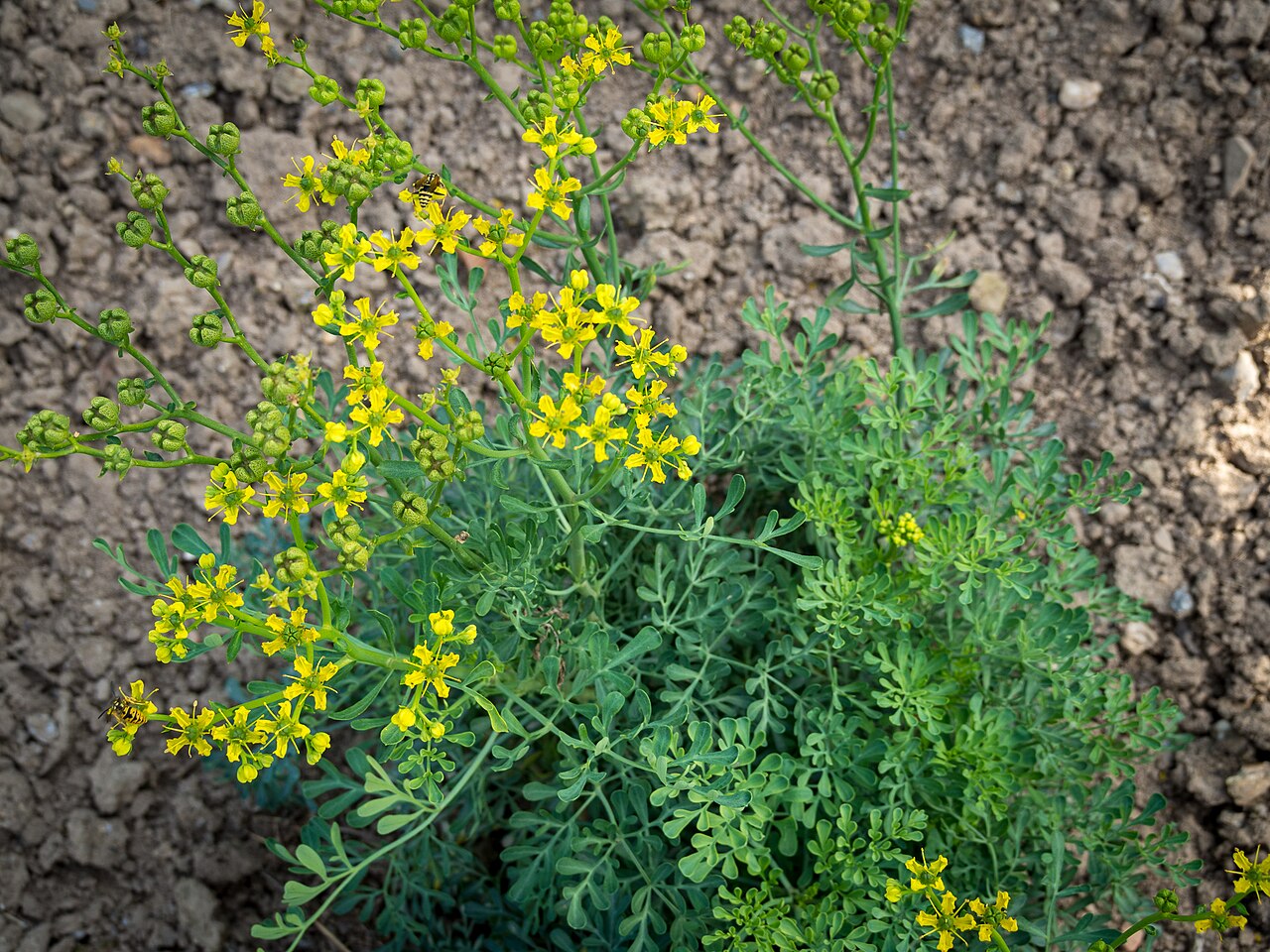
Aruda (Ruta graveolens) sits in pots outside Sri Lankan homes and in the pages of Sri Lankan paediatric tradition — kumara wedakama — where it has long been given to infants for colic. It is also a plant that has killed adults. Those two facts have to be held together, and where they conflict, the toxicology has to win.
Botanical and Cultural Background
Rue is a perennial evergreen subshrub of the Rutaceae family — the citrus family — with distinctive blue-green, deeply divided leaves and clusters of small yellow flowers. Native to the Balkans, it has been grown here for centuries. Crushed, it smells sharp and unmistakable, and it is intensely bitter.
It carries cultural weight beyond medicine: sprigs of aruda are used protectively, tied on children or kept in the home, and the plant appears in ritual as well as remedy across many cultures — the English name, herb-of-grace, records the same idea.
Traditional Uses in Sri Lankan Medicine
Digestive spasms
Rue is antispasmodic and carminative, used traditionally for cramping, colic and flatulence in adults.
Menstrual regulation
A classical emmenagogue — used traditionally to bring on delayed menstruation. This use is the source of its danger.
Respiratory complaints
Leaf decoction used traditionally for cough and chest tightness.
Headache
Crushed leaves applied to the temples.
What the Research Shows
Rue is chemically well characterised. It contains furanocoumarins including bergapten, xanthotoxin and psoralen, along with quinoline alkaloids and the flavonoid rutin — which is named after this plant. Laboratory studies report antispasmodic, anti-inflammatory and antimicrobial activity, consistent with its traditional digestive use.
The furanocoumarins are also why rue burns. They are phototoxic: contact with the fresh plant followed by sunlight causes phytophotodermatitis — blistering burns that can be severe and leave lasting pigmentation. Cases appear regularly in dermatology journals, often in gardeners.
The serious toxicology concerns pregnancy. Rue's emmenagogue reputation has made it a folk abortifacient across many countries, and the medical literature contains reports of severe poisoning and death in women who took it for that purpose — with liver damage, kidney failure and multi-organ failure. The dose that might end a pregnancy and the dose that damages organs are not far apart, which is precisely the problem.
How Aruda Is Prepared
Digestive tea (adults): A small quantity of dried leaf steeped briefly and taken slowly. Rue is used in pinches, not spoonfuls.
Externally: Crushed leaves applied to the temples — with the phototoxicity caution below.
Safety and Precautions
Do not give aruda to infants or young children. This contradicts a genuine strand of Sri Lankan paediatric tradition, and it is still the right advice. Rue is potent enough to cause liver and kidney injury in adults; an infant's dose margin is far narrower, and colic — which is distressing but self-limiting and harmless — is not a reason to take that risk. If a baby is crying inconsolably, a doctor can rule out the causes that matter. Keeping a sprig of aruda near a child is a custom that harms nobody; putting its juice in a baby's mouth is a different act entirely.
Never put aruda juice, or any plant liquid, into an ear. If the eardrum is perforated — and you cannot know — liquid in the middle ear can cause lasting damage and hearing loss, and plant material can introduce infection. Earache needs a doctor, not drops.
Aruda must be avoided completely in pregnancy. It is a documented folk abortifacient, and women have died attempting to use it that way. If you need to end a pregnancy, that is a medical matter with safe options in a clinic; rue is not one of them.
Handle the fresh plant carefully and wash your hands: the furanocoumarins cause severe blistering burns when skin exposed to the sap meets sunlight. Wear gloves when pruning it, and avoid handling it on bright days. High doses are toxic — causing gastric pain, vomiting and liver damage — so keep to small quantities and short courses, and avoid it entirely if you have liver or kidney disease. Do not use it while breastfeeding.

Comments (0)
Leave a Comment