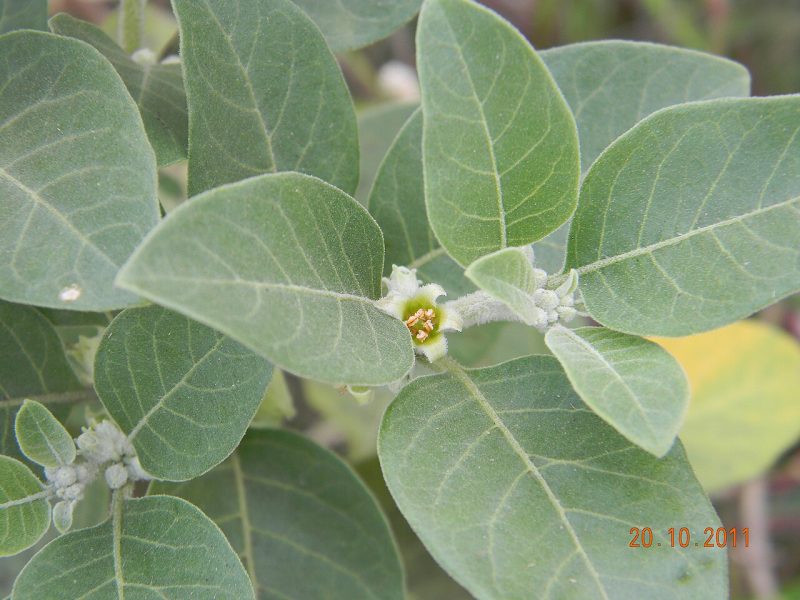
Amukkara (Withania somnifera) has travelled further than almost any herb on this site. Sold worldwide as ashwagandha, it is among the best-researched plants in Ayurveda, with genuine randomised trial evidence behind its central claim. It has also, in the last few years, accumulated enough reports of liver injury that regulators in several countries have taken notice — and that part rarely makes it onto the label.
Botanical and Cultural Background
Amukkara is a short, greyish shrub of the Solanaceae family — the nightshade family — with dull oval leaves and small red berries in papery husks. The medicinal part is the root, which has a distinctive smell often compared to horse, the origin of the Sanskrit name ashwagandha, "horse smell".
Classed as a rasayana and often called Indian ginseng, it belongs to the group of herbs modern writing calls adaptogens — plants said to help the body cope with stress.
Traditional Uses in Sri Lankan Medicine
Stress and sleep
Its central traditional use. The species name somnifera means "sleep-bringing".
Strength and recovery
Traditionally given to build stamina and to restore people convalescing after long illness.
As a milk decoction
Root powder simmered in milk at night is the classic domestic preparation.
What the Research Shows
Ashwagandha has real human evidence, which is uncommon here and worth stating plainly. Randomised, placebo-controlled trials have found reductions in stress and anxiety scores and in cortisol, and a frequently cited trial by Chandrasekhar and colleagues reported meaningful improvements on standard stress scales. Trials have also examined muscle strength, sleep quality and cognition, with generally supportive but smaller and more variable results. The active constituents are the withanolides.
The qualifications are the usual ones: many trials are small, several were industry-funded, they used standardised extracts at defined doses rather than root powder, and durations were typically 8–12 weeks.
The liver signal deserves its own paragraph. Published case series and reports have linked ashwagandha supplements to liver injury, including cases with jaundice and, rarely, severe outcomes. The NIH LiverTox database maintains an entry for it, and health authorities in some countries — Denmark among them — have restricted or advised against its sale on safety grounds. Cases are uncommon relative to how much is consumed, and product adulteration may account for some, but the association is documented and not something a reader should discover afterwards.
How Amukkara Is Prepared
Milk decoction: Half a teaspoon of root powder simmered in a cup of milk, taken before bed.
With ghee and honey: A traditional restorative form.
Standardised extract: The form used in clinical trials.
Safety and Precautions
Stop amukkara and see a doctor if you develop yellowing of the eyes or skin, dark urine, itching, unusual fatigue or right-sided abdominal pain. These are the reported signs of liver injury. Do not take it if you already have liver disease, and be cautious about combining it with other substances that burden the liver, including alcohol.
Avoid it in pregnancy — traditional sources and modern caution agree, as high doses may provoke uterine contractions — and while breastfeeding without professional advice.
Because it stimulates immune activity, avoid it in autoimmune conditions such as rheumatoid arthritis, lupus, Hashimoto's thyroiditis and psoriasis, and if you take immunosuppressants. Ashwagandha raises thyroid hormone levels: do not take it if you have hyperthyroidism, and if you take thyroid medication, speak to your doctor first, as it can push levels too high. It may add to the effect of sedatives and benzodiazepines, and may lower blood sugar and blood pressure — relevant if you take medication for either. Stop it at least two weeks before planned surgery because of its sedative effect.
It belongs to the nightshade family, so anyone with a nightshade sensitivity should avoid it. Mild digestive upset and drowsiness are the common minor effects.



Comments (0)
Leave a Comment