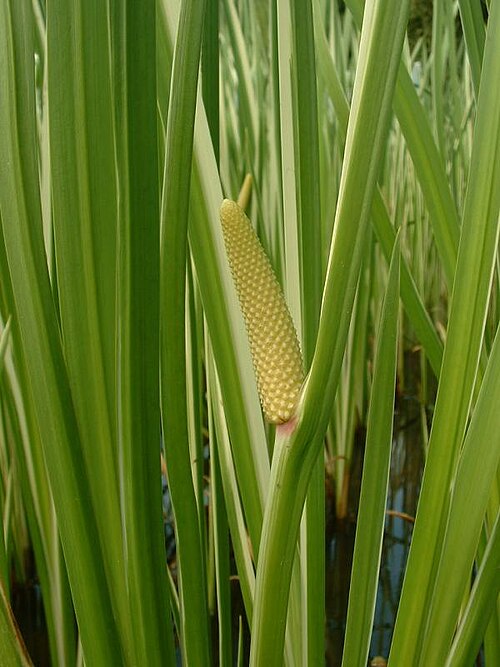
Vada kaha (Acorus calamus) sits awkwardly between reverence and risk. Ayurveda classes it as a medhya rasayana — a rejuvenator of the mind — and Sri Lankan households have long rubbed the root on a stone and given the paste to children. Modern toxicology has a different view of the same plant, and anyone using it deserves to know both.
Botanical and Cultural Background
Vada kaha is a semi-aquatic perennial of the Acoraceae family, with sword-like leaves and a thick, creeping, intensely aromatic rhizome. It grows in marshy ground and along water margins.
Its traditional standing is high and specific: it is associated with speech, voice and mental clarity. The classical practice of rubbing the dried rhizome on a stone with a little water, then giving a trace of the paste with honey, is one of the better-known household remedies in Sri Lanka.
Traditional Uses in Sri Lankan Medicine
Speech and voice
Its most characteristic use — traditionally given to children with delayed speech, and used by singers and reciters for vocal clarity.
Memory and mental clarity
Classed as a brain rejuvenator in Ayurveda and used in formulations for concentration and mental fog.
Digestion
A trace of the powder is used traditionally for colic, cramping and gas.
Sinus congestion
Powdered rhizome has been used traditionally as a snuff to provoke sneezing and clear the sinuses.
What the Research Shows
Research on Acorus calamus has examined effects on the nervous system, along with antimicrobial, anti-inflammatory and insecticidal activity, largely in laboratory and animal models. Its essential oil is dominated by asarones.
Those asarones are the problem. β-asarone has been shown to be genotoxic and carcinogenic in animal studies, and this is not a fringe finding: the United States FDA prohibited calamus and its oil as a food additive in 1968, and European authorities restrict β-asarone levels in food and beverages. Crucially for Sri Lanka, the varieties of Acorus calamus found in South Asia are typically the tetraploid type, which carries the highest β-asarone content — in some samples the great majority of the essential oil. The North American diploid variety is comparatively low in it; ours is not.
So the honest position is this: vada kaha has a genuine traditional reputation and real pharmacological activity, and it also contains a compound that regulators worldwide treat as a carcinogen, in a form that is likely to be high in it.
How Vada Kaha Is Prepared
Traditionally the dried rhizome is rubbed on a rough stone with a few drops of water to yield a paste, a trace of which is mixed with bee honey. A pinch of the powder in warm water is the traditional digestive form.
Quantities in traditional practice are deliberately minute — this has always been a herb of the pinch and the trace, never the spoonful, and that caution was well founded.
Safety and Precautions
Do not give vada kaha to infants or children. This is the clearest advice on this page, and it runs against a genuine tradition, so it is worth being explicit about why. The plant contains a compound that is genotoxic and carcinogenic in animal studies, banned as a food additive in the United States and restricted in Europe; the South Asian variety is the highest-β-asarone form; and children are more vulnerable to such exposures than adults. Speech delay in a child has real causes worth identifying — hearing loss, developmental factors — and a paediatrician or speech therapist can help. Infant colic likewise resolves and should be discussed with a doctor, not treated with a rhizome that carries this profile.
It is contraindicated in pregnancy and breastfeeding.
For adults who choose to use it, traditional practice — trace quantities, short courses only — is not merely custom but the sensible limit. Prolonged or regular use is not advisable. High doses can cause vomiting and, in significant overdose, seizures. Avoid it if you have epilepsy or a seizure disorder, and stop it well before any planned surgery.
If you take medication for the nervous system, including sedatives, tell your doctor before using vada kaha. As with any restricted plant, do not exceed traditional quantities on the assumption that "more is better" — with this herb, more is measurably worse.



Comments (0)
Leave a Comment