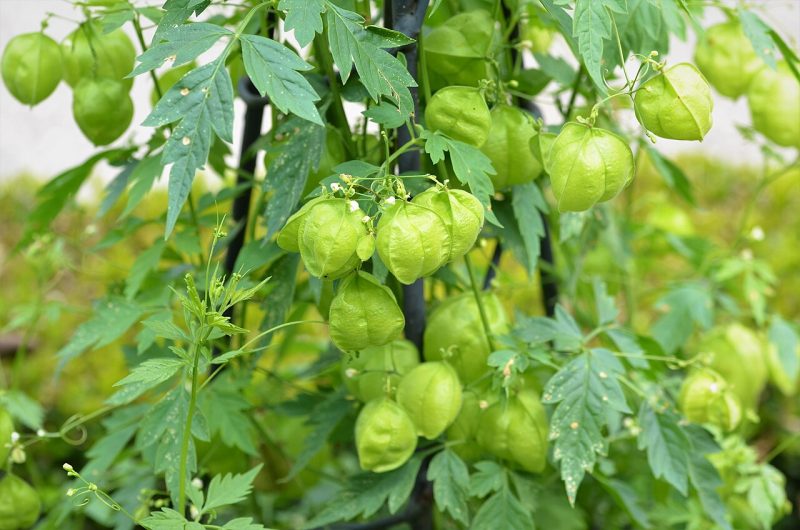
Leaves

Wel Penela (Cardiospermum halicacabum): Balloon Vine for Joints and Skin

(Cardiospermum halicacabum) Last updated Jul 17, 2026
Wel Penela (Cardiospermum halicacabum): Balloon Vine for Joints and Skin
Image Credit: Buendia22, CC BY-SA 4.0 <https://creativecommons.org/licenses/by-sa/4.0>, via Wikimedia Commons

Quick Facts

Sinhala Name වැල් පැණෙල
English Name Balloon Vine
Scientific Name Cardiospermum halicacabum
Plant Family Sapindaceae
Parts Used Leaves, whole plant
Common Uses Joint pain, rheumatism, skin conditions

Wel penela (Cardiospermum halicacabum) is easy to identify and easy to overlook: a slender vine scrambling over fences, hung with papery, inflated green capsules like small lanterns. Each holds black seeds marked with a white heart — the origin of the genus name, Cardiospermum, "heart seed".

Botanical and Cultural Background

A climbing annual or short-lived perennial of the Sapindaceae family, wel penela grows readily on waste ground and hedges throughout Sri Lanka. Leaves, stems and the whole aerial plant are used.

In Sri Lankan practice it belongs to two worlds at once. It is a kenda herb — cooked into porridge as an everyday tonic — and a specific remedy applied to painful joints. It is also eaten as a green in some households.

Traditional Uses in Sri Lankan Medicine

Joint pain and stiffness

Its principal use. Warmed leaves, often with a little sesame oil, are applied over aching or swollen joints.

Skin irritation

Traditionally applied to itching, rashes and eczema-like eruptions.

As a porridge

Wel penela kenda — the leaf juice cooked with rice and coconut milk — is a traditional tonic taken for general wellbeing.

What the Research Shows

Research on Cardiospermum halicacabum has examined anti-inflammatory, analgesic and antipyretic activity in laboratory and animal models, and has identified constituents including flavonoids such as apigenin, along with saponins and phytosterols.

The most interesting thread concerns the skin. Apigenin and related compounds have anti-inflammatory activity, and Cardiospermum extracts have been formulated into topical creams marketed in Europe for eczema and irritated skin, with some studies exploring their use in atopic dermatitis. The evidence is limited and the preparations vary considerably in strength and quality, so this is a promising direction rather than an established treatment.

The claim that wel penela boosts male fertility, stamina or reproductive health is not supported by evidence and should be treated as folklore rather than fact. Traditional rasayana classification describes a broad restorative role in the framework of Ayurveda; it is not a claim about sperm counts.

How Wel Penela Is Prepared

Poultice: Fresh leaves crushed, warmed gently with a little sesame oil, and applied over a painful joint for around half an hour.

Kenda: Leaf juice extracted, cooked with red rice and coconut milk.

As a green: Tender leaves cooked as a mallum.

Safety and Precautions

Wel penela is eaten as food in Sri Lanka and external use is generally well tolerated, which puts it among the gentler herbs on this site. Test a small area of skin first if you are prone to irritation.

Avoid medicinal quantities during pregnancy: traditional sources describe it as capable of stimulating uterine contractions in higher doses, and that caution is worth respecting. Avoid it while breastfeeding without professional advice.

Joint pain deserves a word of realism. Arthritis is a broad label covering conditions that differ enormously — osteoarthritis, rheumatoid arthritis, gout — and rheumatoid arthritis in particular causes irreversible joint damage if untreated, while effective medicines exist that change its course. A poultice may ease discomfort; it does not modify disease. Persistent joint pain, swelling, or morning stiffness lasting more than half an hour deserves a proper diagnosis rather than indefinite home treatment.
Scientific References

  • Asha, V.V. & Pushpangadan, P. (1999). Antipyretic activity of Cardiospermum halicacabum. Indian Journal of Experimental Biology, 37(4), 411–414.
  • Raza, S.A., Hussain, S., Riaz, H. & Mahmood, S. (2013). Review of beneficial and remedial aspects of Cardiospermum halicacabum L. African Journal of Pharmacy and Pharmacology, 7(48), 3026–3033.
  • Sheeba, M.S. & Asha, V.V. (2009). Cardiospermum halicacabum ethanol extract inhibits LPS-induced COX-2, TNF-α and iNOS expression. Journal of Ethnopharmacology, 124(1), 39–44.
  • Niedner, R. (2004). Therapy of atopic eczema with Cardiospermum halicacabum. Der Deutsche Dermatologe.
  • Jayaweera, D.M.A. (1982). Medicinal Plants (Indigenous and Exotic) Used in Ceylon. National Science Council of Sri Lanka, Colombo.

Frequently Asked Questions

What is Wel Penela called in English?

Wel Penela (Cardiospermum halicacabum) is called balloon vine or heart seed in English, named for its inflated papery capsules and for the black seeds marked with a white heart.

Does Wel Penela boost male fertility or stamina?

This claim is not supported by evidence and is best treated as folklore. Its traditional rasayana classification describes a broad restorative role within the Ayurvedic framework — it is not a claim about fertility or sperm counts.

Can Wel Penela help eczema?

This is the most interesting research thread. Cardiospermum extracts have been formulated into topical creams marketed in Europe for eczema and irritated skin, with some studies in atopic dermatitis. The evidence is limited and preparations vary in strength, so it is a promising direction rather than an established treatment.

Is a poultice enough for arthritis?

It may ease discomfort, but it does not modify disease. Arthritis covers very different conditions — rheumatoid arthritis in particular causes irreversible joint damage if untreated, and effective medicines exist that change its course. Persistent joint pain, swelling or morning stiffness over half an hour deserves a diagnosis.

Medical Disclaimer The information on this page is for educational purposes only and is not a substitute for professional medical advice, diagnosis, or treatment. Always consult a qualified physician or Ayurvedic practitioner before using any herbal remedy, especially if you are pregnant, nursing, taking medication, or have a medical condition. Read our full disclaimer
Siyera Jasing Arachchi

Edited by Siyera Jasing Arachchi

As a Biotechnology and Microbiology undergrad and Subject Matter Expert (SME) Content Curator, I'm passionate about leveraging science to improve lives and protect our planet. My academic focus spans genetics, molecular biology, bioinformatics, and sustainable agriculture. Inspired by nature and photography, I am actively seeking collaborative opportunities to contribute to impactful scientific research.


Comments (0)

Leave a Comment