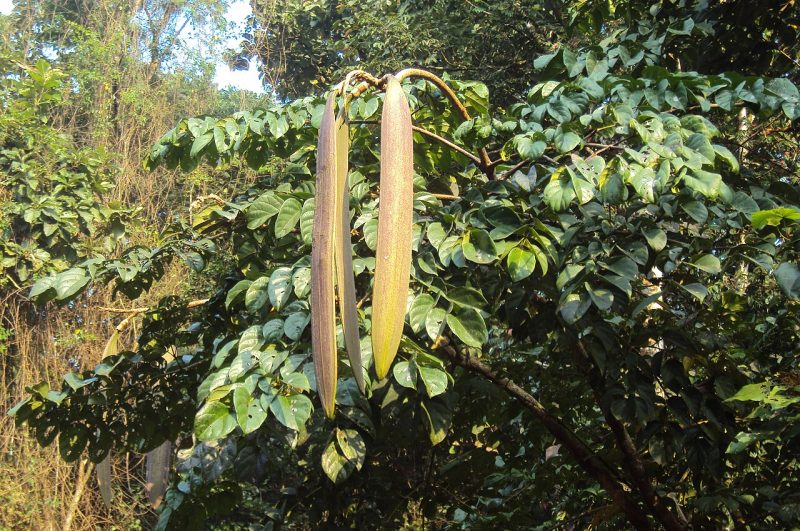
Thotila (Oroxylum indicum) is unmistakable once you have seen it: a slender tree hung with enormous sword-shaped pods, and at night, large fleshy flowers that open and smell unpleasant to draw the bats that pollinate them. It is one of the ten roots of Dasamula, and it is one of the more potent plants in Sri Lankan practice.
Botanical and Cultural Background
Thotila is a small to medium tree of the Bignoniaceae family, with very large compound leaves and flat pods up to a metre long that hang like scabbards — the origin of the name Indian trumpet tree, and of local names referring to swords. The medicinal part is the root bark, and the stem bark is also used.
Its place in Dasamula — the ten roots that form the backbone of many classical Ayurvedic formulations — puts it in the same company as katuwelbatu, and signals the regard traditional physicians have for it.
Traditional Uses in Sri Lankan Medicine
Joint pain and inflammation
Its principal use. Root bark decoctions are given for arthritis and joint swelling, in traditional terms for aggravated vata.
Digestion
The bitter bark is used as a tonic to stimulate appetite and digestion.
Respiratory complaints
Bark decoction is traditionally used for cough and bronchitis.
In Dasamula preparations
Thotila is a key ingredient of Dasamularishta, widely used as a restorative, including after childbirth.
What the Research Shows
Research on Oroxylum indicum has identified flavonoids including baicalein, chrysin and oroxylin A, and has examined anti-inflammatory, antioxidant, antimicrobial and anticancer activity, largely in laboratory and animal models. Dinda and colleagues' review covers this literature in detail. Baicalein in particular is a well-studied flavonoid.
Human clinical evidence for thotila's traditional uses is absent. Its standing rests on classical practice and on preclinical pharmacology, and the anticancer laboratory findings — which appear in some popular writing — are cell-culture work and say nothing about treating cancer in a person.
How Thotila Is Prepared
Decoction: Root or stem bark boiled in water, sometimes with garlic and ginger.
In classical formulations: Most commonly encountered as part of Dasamularishta rather than alone.
Thotila is potent and traditionally used within compound preparations at controlled doses rather than casually at home.
Safety and Precautions
Never pour thotila juice — or any plant juice, oil or liquid — into an ear. This traditional remedy for earache should be abandoned completely. If the eardrum is perforated, and you cannot know whether it is, liquid entering the middle ear can cause serious damage and permanent hearing loss; non-sterile plant material can also introduce infection into an already infected ear. Earache is common in children and usually comes from a middle ear infection that a doctor can assess in minutes. Ear pain with discharge, fever, swelling behind the ear or hearing loss needs medical attention, not drops from a tree.
Thotila is a potent plant and traditional practice is right to insist it be used under the guidance of a qualified Ayurvedic physician, at controlled doses, rather than self-prescribed.
Avoid it in pregnancy without professional supervision — note that Dasamularishta is traditionally given after childbirth rather than during pregnancy, and arishta preparations also contain alcohol. Do not use it as a substitute for asthma medication. Persistent joint pain deserves a diagnosis: rheumatoid arthritis causes irreversible damage untreated, and effective medicines exist that change its course.



Comments (0)
Leave a Comment