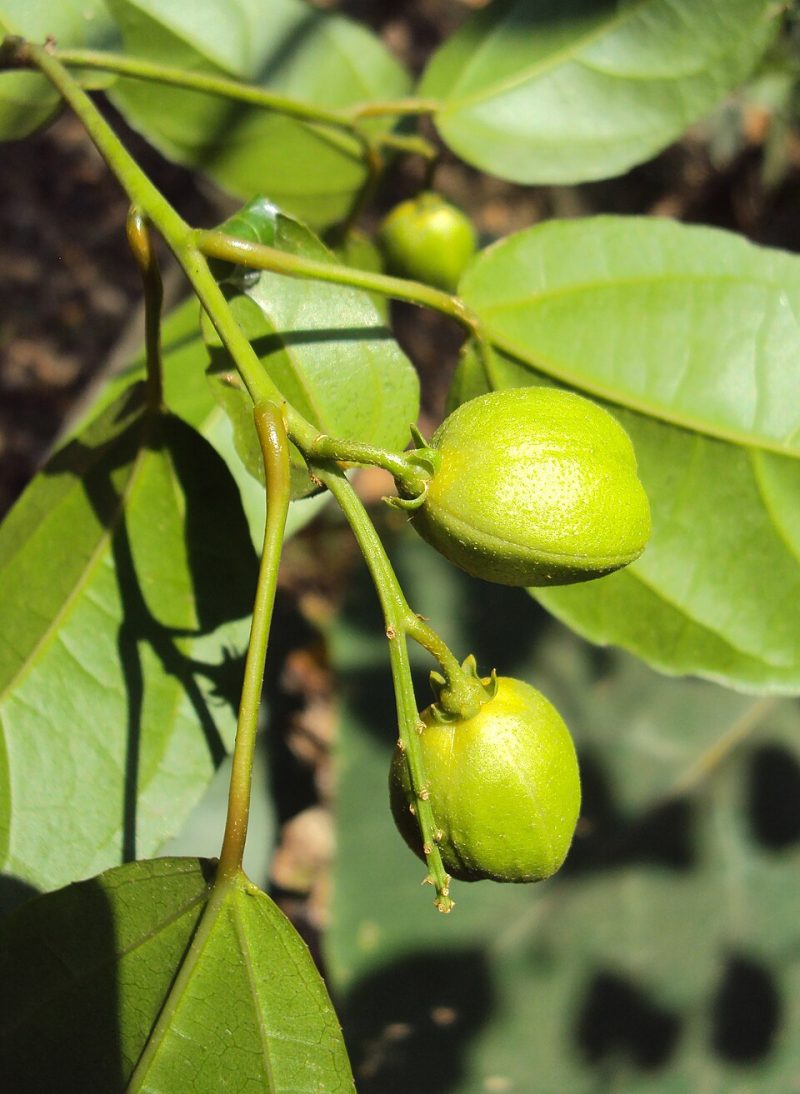
Jayapala (Croton tiglium) is classed in Ayurveda as upavisha — semi-poisonous — and the classification is generous. Half a raw seed can put an adult in hospital. It survives in the pharmacopoeia only because centuries of practitioners worked out how to strip its poison away, and it belongs on this site chiefly so that people understand why they must not touch it.
Botanical and Cultural Background
Jayapala is a small evergreen tree of the Euphorbiaceae family, cultivated in Sri Lanka specifically as a medicinal plant. Its capsule fruits hold three seeds that look much like castor beans — a resemblance worth knowing about, since both are dangerous and neither should be eaten.
Its place in tradition is as a drastic purgative (virechana) of last resort, and always after purification.
Traditional Uses in Sri Lankan Medicine
All of the following apply only to properly purified material prescribed by a qualified physician, never to the raw plant.
Intractable constipation
Purified jayapala is used as a drastic purgative where gentler laxatives have failed.
Ascites and severe fluid retention
Traditionally given in minute doses to purge fluid in abdominal swelling.
Stubborn intestinal worms
The violent purgative action is used to flush parasites out.
Alopecia areata
Highly diluted croton oil is used by specialists as a deliberate scalp irritant.
What the Research Shows
Croton oil's chemistry is famous, though not for good reasons. It contains phorbol esters, the compounds responsible for its violent irritant and purgative action. Phorbol esters work by activating protein kinase C, and one of them — TPA, isolated from croton oil — became the standard tumour promoter used in laboratory carcinogenesis research worldwide. For decades, when scientists needed to reliably promote tumour growth on mouse skin in an experiment, croton oil derivatives were what they reached for.
That is a sobering thing to know about a plant applied to human scalps, and it deserves stating plainly: the active principle of croton oil is the archetypal experimental tumour promoter. This is a genuine argument against casual or repeated external use, quite apart from the burns.
Research also documents the plant's severe gastrointestinal toxicity, and the traditional shodhana purification has been studied for its effect on phorbol ester content.
The Traditional Purification (Shodhana)
Purification is not optional decoration — it is the entire basis on which this plant is usable. The seed coat and the embryo, which carry the highest toxicity, are removed by hand. The remaining material is tied in cloth and boiled in cow's milk for hours by the dola yantra method, reducing the irritant content. Only then is it compounded, in minute doses, usually with ghee or milk to blunt its action.
Safety and Precautions
Jayapala must never be used as a home remedy under any circumstances. Consuming even half a raw seed can cause severe abdominal pain, explosive bloody diarrhoea, vomiting, blistering of the mouth and throat, collapse from dehydration, respiratory failure and death. Croton oil on skin causes chemical burns and blistering. There is no safe way to experiment with this plant.
If someone has swallowed jayapala seeds, go to hospital immediately — do not wait for symptoms, and take the plant material with you. The seeds resemble castor beans and are exactly the kind of thing a curious child picks up. If you grow it, know where it is and keep children away.
Ascites is not a home-treatment condition. Fluid in the abdomen usually signals advanced liver disease, heart failure or cancer, and the traditional response of violent purging is dangerous in exactly those patients — it can crash blood pressure, wreck electrolytes and precipitate hepatic encephalopathy. This needs a hospital.
Internal use belongs solely to registered Ayurvedic physicians using purified material at controlled doses. It must never be given to pregnant women, children or elderly or frail patients. Given the phorbol ester findings, repeated external application is unwise.

Comments (0)
Leave a Comment