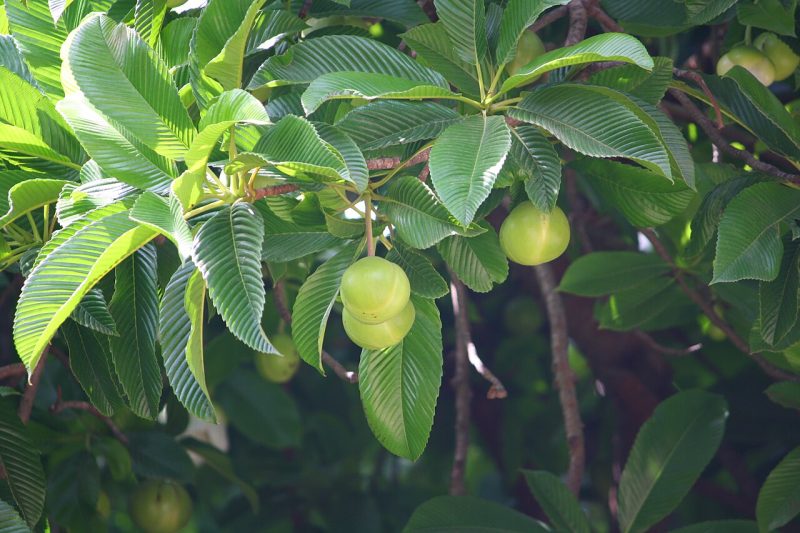
Godapara (Dillenia retusa) is endemic to Sri Lanka — it grows wild nowhere else on earth. Before shampoo came in bottles, its fruit was what Sri Lankan villages used to wash their hair, and anyone who has squeezed the slippery gel out of a godapara fruit understands immediately why.
Botanical and Cultural Background
Godapara is a tree of the Dilleniaceae family, found in the wet zone and lower hill country, with large leathery leaves marked by prominent parallel veins and showy white flowers. What is called the fruit is really a mass of thick fleshy sepals closing around the true fruit, and crushing it releases an abundant clear mucilage.
That mucilage is the point. It lathers slightly, rinses clean, and leaves hair soft — a natural shampoo and conditioner that predates every product on the shelf. Sri Lanka has a genuine tradition of hair-care plants, documented in ethnobotanical surveys, and godapara sits near the centre of it.
Traditional Uses in Sri Lankan Medicine
Hair washing and dandruff
Its defining use — the fruit gel applied to the scalp, left briefly, and rinsed out.
Conditioning
The mucilage detangles and softens hair, which is much of why the practice survived.
Cooling the head
The gel is considered cooling, used before a bath for heat and headache.
Skin
Astringent bark decoctions are used traditionally to wash skin ulcers.
What the Research Shows
Sri Lankan ethnobotanical work — Dharmadasa and colleagues surveyed plants used for hair care here — documents godapara's traditional role. Studies of Dillenia species report antimicrobial, antioxidant and anti-inflammatory activity in laboratory models, and the genus contains flavonoids and triterpenoids.
There are no clinical trials of godapara for dandruff. That said, the standard being applied matters: this is a cosmetic wash, not a drug. The mucilage plainly cleans and conditions hair — that much anyone can verify — and the claim worth being careful about is the stronger one, that it is a "guaranteed cure" for severe dandruff. Persistent dandruff is usually seborrhoeic dermatitis, driven by Malassezia yeast, and it responds to antifungal shampoos rather than to washing alone.
How Godapara Is Prepared
Herbal shampoo: Ripe or semi-ripe fruit crushed on a stone, a little water added, and the thick gel squeezed out. Applied to the scalp, left fifteen to thirty minutes, and rinsed.
Before a bath: The gel applied to the head as a cooling treatment.
Safety and Precautions
Godapara is an external cosmetic preparation and is about as safe as anything on this site. Rinse it out thoroughly and avoid the eyes. Do a patch test if your skin is sensitive.
If dandruff is severe or keeps returning, it is probably seborrhoeic dermatitis and there is a real treatment for it. Antifungal shampoos containing ketoconazole, selenium sulphide or zinc pyrithione are inexpensive, available from any pharmacy, and target the yeast that causes it. Scalp scaling with redness, thick silvery plaques, hair loss or spreading beyond the scalp should be seen by a doctor — psoriasis and fungal infections of the scalp look similar to dandruff and are treated quite differently.
Godapara is endemic to Sri Lanka, which is worth remembering when harvesting: take fruit, not branches, and leave enough for the tree and the wildlife that depend on it.



Comments (0)
Leave a Comment