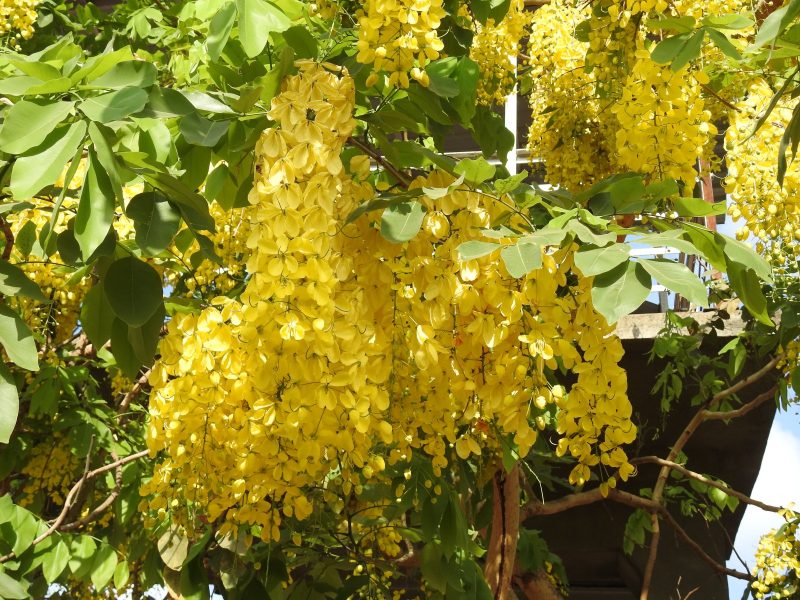
Every April, as the koha starts calling and families get ready for the Sinhala and Tamil New Year, ehela trees along village roads hang out long chains of golden flowers. For many Sri Lankans, that sight means Avurudu has come. Later it carries straight, dark pods a foot or two long, filled with the sticky black pulp our grandparents used as a gentle laxative.
Botanical and Cultural Background
Ehela (Cassia fistula) is a medium-sized tree of the pea family, Fabaceae, native to the Indian subcontinent. It grows wild in the dry and intermediate zones and is planted in gardens and temple grounds island-wide. Between March and May it flowers in hanging bunches 20–40 cm long. The cylindrical pods turn almost black and do not split; thin cross-walls divide them into chambers, each holding a flat seed in sweet-smelling dark pulp. In Sanskrit the tree is aragvadha or rajavriksha, “the king’s tree”, and in Tamil konrai. It is recorded in Jayaweera’s survey of Ceylon’s medicinal plants, and Ayurveda and Deshiya Chikitsa class the fruit pulp as a mild purgative.
Traditional Uses in Sri Lankan Medicine
- Constipation — black pod pulp soaked in warm water and taken at night; ehela’s best-known use.
- Gentle bowel clearing — Ayurveda counts aragvadha among the mildest purgatives, given when a physician advises it.
- Itchy skin and ringworm — a paste of young leaves applied to the patches.
- Physician-made decoctions — part of the classical aragvadhadi decoction for skin complaints and some fevers; not a home remedy.
What the Research Shows
The best human evidence is for constipation in children. In a 2012 trial in Iran, 81 children aged 4–13 took an emulsion of dried ehela pulp or mineral oil for three weeks; 84% of the ehela group no longer met the criteria for constipation, against 50% on mineral oil. A 2016 trial by the same team in 109 children found it worked about as well as polyethylene glycol, a standard laxative (86.5% vs 77.1% improved, not a significant difference). Loose motions affected about one child in three or four and settled when the dose was lowered.
These were small, single-centre trials in which everyone knew which treatment was given. A 2022 systematic review concluded that ehela emulsion may help, but the studies carry a high risk of bias and better trials are needed. We found no comparable trials in adults.
Lab and animal studies report antioxidant, antimicrobial, anti-inflammatory, blood-sugar-lowering and liver-protecting effects; none is proven in people.
Evidence updated November 2026.
How Ehela Is Prepared
- Pulp water for adults — crack a dry black pod, scrape out the pulp and discard the seeds. Soak one to two teaspoons of pulp (about 5–10 g) in a cup of warm water for half an hour, mash, strain and drink at bedtime. Start with the smaller amount.
- Leaf paste — grind washed young leaves with a little water, apply thinly and wash off after half an hour.
- For children — the trials used a measured emulsion (0.1 g dried pulp per kg body weight a day, in three doses). Do not guess a dose at home; ask a doctor.
Safety and Precautions
Ehela pulp contains anthraquinones, like senna, and works by stimulating the bowel. Too much causes cramps and diarrhoea. Use it for a few days only: long-term use of stimulant laxatives can drain fluids and potassium. Do not eat the seeds or use the bark at home.
- Avoid in pregnancy and breastfeeding unless a doctor advises it.
- Never give it to babies; older children only on a doctor’s advice.
- Not with severe stomach pain, vomiting, suspected bowel blockage or inflammatory bowel disease.
- On digoxin, water tablets or steroids? Ask your doctor first, as laxatives can lower potassium.
- See a doctor if constipation lasts over two weeks, or comes with blood in the stool, weight loss or a new change in bowel habit after 50.

Comments (0)
Leave a Comment