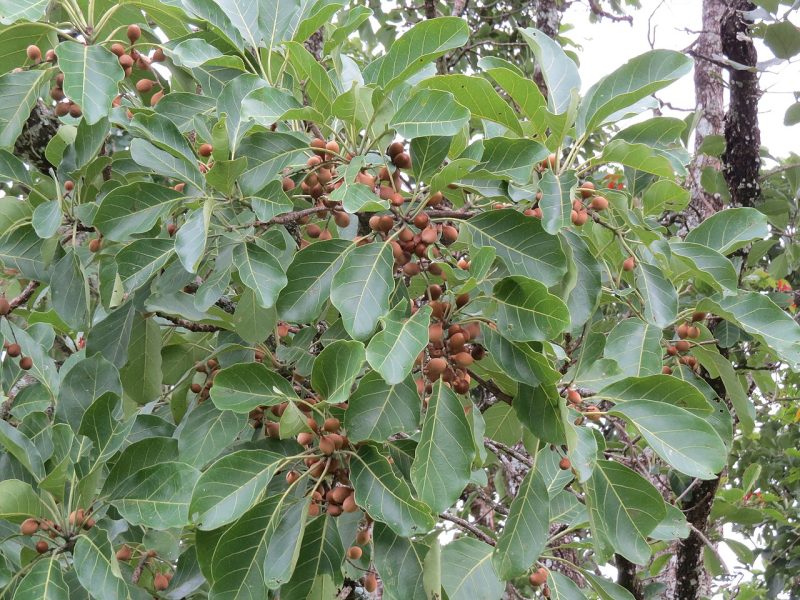
Bulu (Terminalia bellirica) is the least famous member of a famous trio. Where aralu and nelli are widely known in their own right, bulu is encountered mostly as the third fruit in Triphala — and yet without it the formulation would not exist in the form Ayurveda has used for centuries.
Botanical and Cultural Background
Bulu is a tall deciduous tree of the Combretaceae family — the same family as aralu — reaching thirty metres or more, with a straight trunk and leaves clustered toward the ends of branches. The fruit is a rounded, greyish drupe, dried for medicinal use.
Known as bahera or vibhitaki in Ayurveda, bulu is classified as the fruit that addresses kapha — the traditional principle associated with mucus, heaviness and water in the body. This is why its uses cluster around the chest, throat and phlegm.
Traditional Uses in Sri Lankan Medicine
Throat and voice
Bulu's most characteristic use. The powder with honey is a traditional remedy for hoarseness, a scratchy throat and dry cough. Traditional singers and reciters have used it for the voice.
Cough and phlegm
It is used where cough comes with thick mucus, reflecting its classification as a kapha-reducing fruit.
Digestion
Bulu is a mild laxative, gentler than aralu, and is used for sluggish digestion.
In Triphala
Its principal role: equal parts aralu, bulu and nelli, taken for digestive regularity.
What the Research Shows
Research on Terminalia bellirica has identified tannins, gallic acid, ellagic acid and lignans including termilignan and thannilignan, and has examined antioxidant, antimicrobial, hepatoprotective and lipid-lowering activity, mostly in laboratory and animal models.
There is some human research on Triphala as a whole, particularly around digestive function and oral health, though the trials are small and variable in quality. For bulu on its own, human clinical evidence is thin. Its traditional reputation for the throat is well established in practice; it is not the same as demonstrated clinical effect.
How Bulu Is Prepared
With honey: Half a teaspoon of dried fruit powder mixed with bee honey and taken slowly, allowing it to coat the throat.
Triphala: Equal parts aralu, bulu and nelli powder in warm water.
Gargle: A decoction of the dried fruit, cooled and used as a mouth rinse for sore throat.
The stone is removed; only the dried pulp is used.
Safety and Precautions
Bulu is generally well tolerated in the small quantities traditionally used. Large amounts may cause nausea or vomiting, and because it has a laxative action, overuse can cause loose stools.
Do not put bulu preparations in your eyes. Traditional texts mention external use for eye complaints, and this is one place where tradition should not be followed at home: the eye is delicate and easily damaged, non-sterile preparations risk introducing infection, and conjunctivitis and other eye infections have safe, effective medical treatments. Eye symptoms need a doctor.
Avoid medicinal quantities in pregnancy and breastfeeding without professional advice. Like aralu, bulu is high in tannins, which may reduce absorption of medicines taken at the same time — separate doses by at least two hours. It may also affect blood sugar, so people on diabetes medication should use it with awareness. A hoarse voice or sore throat lasting more than three weeks needs medical assessment rather than continued home treatment.



Comments (0)
Leave a Comment