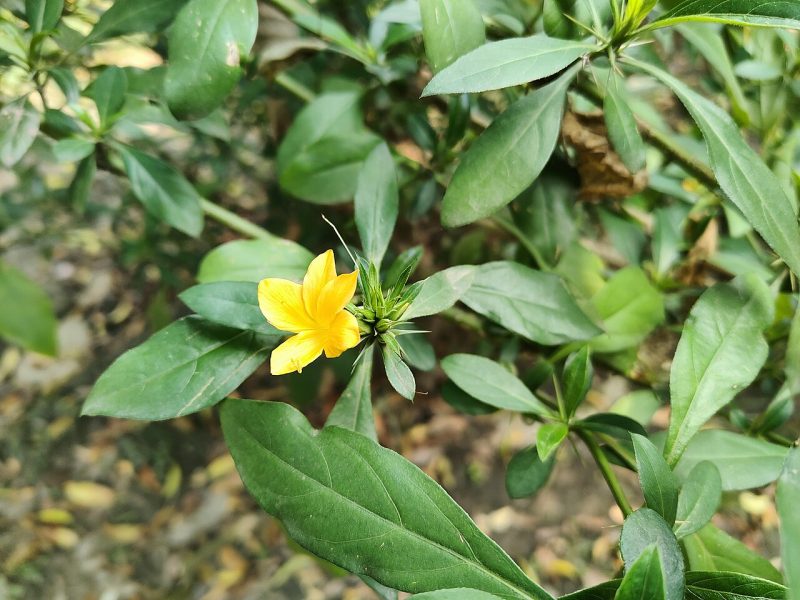
Katu Karandu (Barleria prionitis) defends itself with pale spines at every leaf joint — the porcupine flower, bristling and yellow-flowered, growing in dry rocky ground where little else bothers. Its medicine is mostly about the mouth.
Botanical and Cultural Background
Katu Karandu is a prickly much-branched perennial shrub of the Acanthaceae family — pawatta's family — with glossy leaves, sharp axillary spines and tubular golden-yellow flowers. It is native to Sri Lanka and India and grows in dry zone scrub.
Known in Sanskrit as kurantaka, all its parts are used, but the leaves and bark carry its reputation.
Traditional Uses in Sri Lankan Medicine
Gums and teeth
Its defining use — leaves chewed or boiled into a mouthwash for bleeding gums, ulcers and toothache.
Joint pain
Root decoction internally, or warm leaf paste applied externally.
Cough
Leaf juice with honey, traditionally as an expectorant.
Skin
Crushed leaves applied to boils and wounds.
What the Research Shows
Barleria prionitis contains iridoid glycosides — barlerin, acetylbarlerin — along with flavonoids and tannins, and studies report antibacterial, anti-inflammatory, antioxidant and hepatoprotective activity in laboratory models. Research on its antibacterial action against oral pathogens is the most relevant strand, and some work has examined Barleria-containing dental preparations.
The tannins give a real basis for the astringent effect on gum tissue, much as with munamal. Human clinical evidence remains thin.
How It Is Prepared
Mouthwash: Leaves boiled, strained and the cooled decoction used as a daily rinse.
Leaf juice: Applied to an aching tooth or sore gum.
Joint paste: Leaves crushed with warm water and applied — mind the spines when harvesting.
Safety and Precautions
Katu Karandu is well tolerated as a mouthwash. Harvest it carefully: the spines are sharp enough to cause painful puncture wounds, and a deep dirty puncture is worth a tetanus check.
The mouth is where the honesty is needed. Astringent tannins tighten gum tissue and can genuinely make gums feel firmer and bleed less — but bleeding gums are gingivitis, and teeth that loosen mean periodontal disease has already destroyed the bone anchoring them, which does not grow back. A rinse cannot reach below the gumline; a dentist's scaling can, and it stops the process. Feeling better while the bone quietly disappears is the worst possible outcome. Use the rinse if you enjoy it, and get your teeth cleaned properly.
Toothache means a cavity or an abscess. Numbing it changes nothing about the decay, and an untreated dental abscess can spread to the face and neck. See a dentist.
Do not rely on it for asthma — an inhaler is not optional. Avoid medicinal internal use in pregnancy without professional advice, and do not swallow large amounts of the decoction.

Comments (0)
Leave a Comment