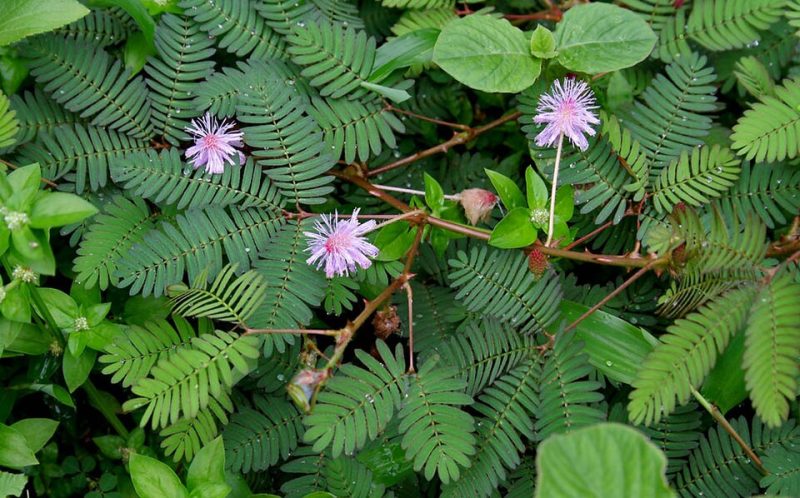
Nidikumba (Mimosa pudica) is the plant every Sri Lankan child has poked. Touch a leaf and it folds shut within a second, the whole frond collapsing as if asleep — the origin of both its Sinhala name and its English one. It is also a serious astringent medicine, which is easy to forget about a plant used as a toy.
Botanical and Cultural Background
Nidikumba is a creeping herb of the Fabaceae family with fine feathery leaflets, thorny stems and pink pom-pom flowers. Native to South and Central America, it is thoroughly naturalised here and grows as a weed in grass and open ground.
Its folding — thigmonasty — is a rapid loss of turgor in cells at the leaf base in response to touch, heat or shaking. The name nidikumba refers to sleep, and the plant's traditional sedative reputation traces to the same observation.
Traditional Uses in Sri Lankan Medicine
Wounds and bleeding
Crushed leaf paste applied to cuts and ulcers — its tannins make it markedly astringent.
Piles
One of its best-known uses, root or whole-plant decoction taken internally with leaf paste applied.
Loose stools
Astringent decoction used traditionally for diarrhoea.
Joint pain
Warmed leaf poultice applied externally.
What the Research Shows
Research on Mimosa pudica reports antimicrobial, antioxidant, wound-healing and antivenom activity in laboratory and animal models, and identifies tannins, flavonoids and the alkaloid mimosine. The astringent, haemostatic tradition is mechanistically plausible.
Animal studies have also reported antifertility effects, which is the basis of the pregnancy caution below and is worth taking seriously rather than treating as boilerplate.
Human clinical evidence is absent.
How Nidikumba Is Prepared
Wound poultice: Fresh clean leaves crushed to a paste and applied.
Decoction: Whole plant with roots boiled down and strained.
Joint paste: Leaves ground with warm water and applied.
Safety and Precautions
Amoebic dysentery needs a specific drug, not an astringent. The article traditions around nidikumba include amoebic dysentery — but amoebiasis is an infection with Entamoeba histolytica, it is treated with metronidazole or similar, and untreated it can spread beyond the gut and form a liver abscess. Firming the stool while that continues is not treatment. For any diarrhoea, oral rehydration solution comes first; blood or mucus in the stool means see a doctor.
Bleeding piles and heavy periods both mean "get checked". Bleeding from the back passage should never simply be assumed to be piles — it is also how bowel cancer presents, and that assumption costs lives, particularly over the age of forty. Heavy menstrual bleeding likewise has causes worth finding: fibroids, thyroid disease, clotting disorders, and it commonly causes iron-deficiency anaemia that needs treating. Nidikumba's astringency may reduce visible bleeding while leaving the cause untouched.
Avoid internal use in pregnancy and while breastfeeding — the antifertility findings in animals make this more than a formality. Overuse of the decoction causes constipation. Harvest away from roadsides and sprayed areas, since it grows as a weed exactly where contamination is likeliest.

Comments (0)
Leave a Comment