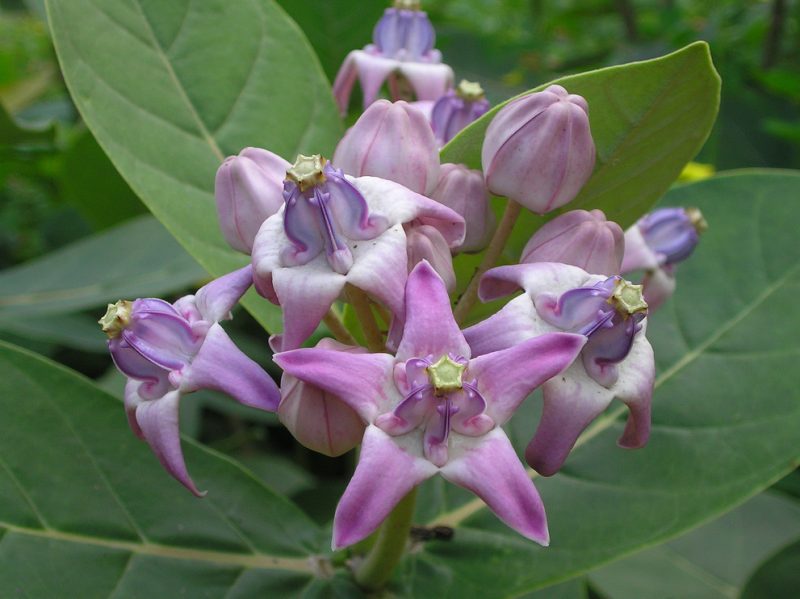
Wara (Calotropis gigantea) grows where almost nothing else bothers to — sand, waste ground, the edges of dry-zone roads — and offers up crown-shaped flowers used in temple offerings. Break any part of it and it bleeds thick white latex. That latex can take your sight, and swallowing this plant can stop your heart. It is also a genuinely useful external remedy, which is why it needs careful handling rather than avoidance.
Botanical and Cultural Background
Wara is a large shrub of the Apocynaceae family — the dogbane family, which contains many toxic plants — with thick oval leaves covered in fine white down, and clusters of waxy crown-like flowers in white or dusty purple. It exudes copious white latex from any break.
The flowers have religious significance and are offered at temples. The plant is also a host for milkweed butterflies, which sequester its toxins for their own defence — a good clue to what it contains.
Traditional Uses in Sri Lankan Medicine
Joint pain
Its most celebrated use. A leaf smeared with oil, warmed over a flame and bound over an aching joint.
Heel pain
A well-known Sri Lankan folk remedy for heel spurs and plantar fasciitis — a warmed leaf placed inside the shoe or stood upon.
Skin lesions
The latex applied traditionally, very sparingly, to ringworm and warts.
In processed formulations
Purified preparations such as arka kshara are used by specialist practitioners for respiratory conditions.
What the Research Shows
Research on Calotropis gigantea has reported anti-inflammatory and antimicrobial activity for the latex and leaf extracts, which fits the traditional external use. Kumar and Basu's work on the latex's anti-inflammatory activity is among the more cited.
The critical finding is what the plant contains: cardiac glycosides. Wara's latex holds cardenolides — calotropin, uscharin, calactin and others — which act on the heart in the same way as digoxin, the drug derived from foxglove. This is not a theoretical concern. Calotropis poisoning is documented across South Asia, and in Sri Lanka and India it appears in the clinical literature both as accidental ingestion and, more often, as deliberate self-harm. It produces vomiting, abdominal pain, dangerous disturbances of heart rhythm and, in severe cases, death. The heart effects are the reason this plant is more dangerous than its "irritant sap" reputation suggests.
The latex is also a well-documented cause of eye injury. Ocular exposure — usually from rubbing an eye after handling the plant — causes corneal oedema and painful keratitis, with blurred vision that can take days to resolve. Cases are regularly reported from Sri Lankan and Indian eye clinics.
How Wara Is Prepared
Joint poultice: A large leaf coated with sesame or castor oil, warmed over a flame until soft, and bound over the joint with cloth.
Heel remedy: A warmed leaf placed in the shoe.
External use only, and always with hand-washing afterwards.
Safety and Precautions
Never let the latex near your eyes. This is the practical danger most people meet. Wara latex causes corneal injury and painful keratitis with blurred vision, and cases fill eye clinics in this region. It happens by accident — you handle the plant, then rub your eye. Wash your hands with soap immediately after touching wara, every time. If sap does get in an eye, rinse with clean running water for at least fifteen minutes and go to a doctor the same day; do not wait to see whether it settles.
Never swallow any part of this plant. Wara contains cardiac glycosides that act on the heart like digoxin. Ingestion causes vomiting, abdominal pain and dangerous heart rhythm disturbances, and it kills. If someone has swallowed wara — including a child who has chewed a leaf, or anyone who has taken it deliberately — this is an emergency: go to hospital immediately, take a piece of the plant to show them, and say what was taken. Do not wait for symptoms.
Keep children away from the plant, and teach them not to break the stems. Internal use belongs strictly to purified formulations prepared by qualified practitioners, and even then it is not something to seek out casually. Do not use wara on broken skin, and do not use it in pregnancy or while breastfeeding.

Comments (0)
Leave a Comment