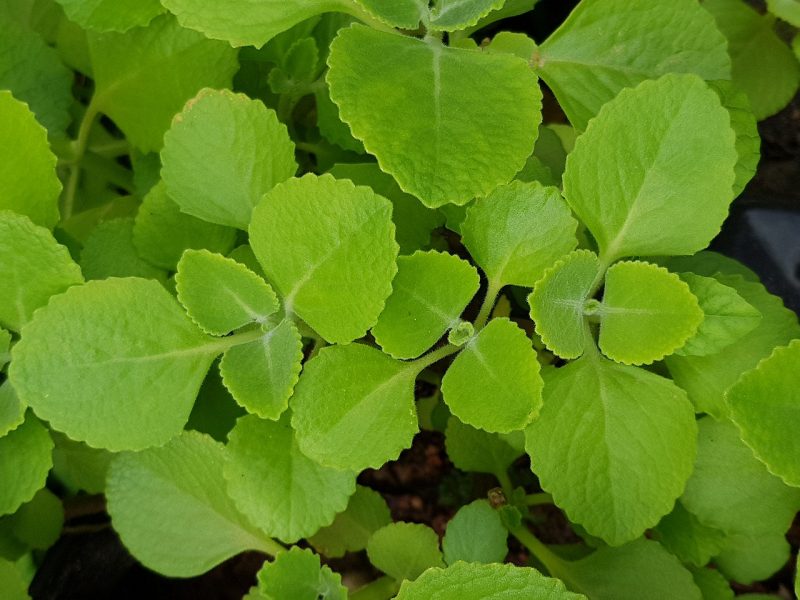
Kapparawalliya (Plectranthus amboinicus) is the plant Sri Lankan households reach for the moment a child starts coughing. Thick, velvety, aggressively aromatic leaves, growing in a pot by the door — a leaf wilted over a flame, squeezed, and mixed with honey is one of the most familiar home remedies in the country.
Botanical and Cultural Background
Kapparawalliya is a succulent perennial of the Lamiaceae family — the mint family — with thick fleshy leaves covered in fine hairs and a strong oregano-like smell. It grows easily from a cutting and needs almost no care.
Its English names — Indian borage, Cuban oregano, Mexican mint — record how widely it has travelled and how often it has been adopted as a household cough remedy.
Traditional Uses in Sri Lankan Medicine
Cough and congestion
Its defining use — leaf juice with honey for cough and blocked chest.
Steam inhalation
Crushed leaves in hot water, inhaled for a blocked nose.
Digestion
Aromatic oils used traditionally for cramping and bloating.
Skin
Crushed leaves applied to bites and stings.
What the Research Shows
Kapparawalliya's essential oil is rich in carvacrol and thymol — the same compounds that make oregano and thyme pharmacologically interesting. Both are well documented as antimicrobial in laboratory studies, and thymol has genuine expectorant history; it appears in commercial cough and mouthwash preparations. Laboratory work also reports antispasmodic and anti-inflammatory activity.
This gives the traditional use a plausible mechanistic basis, which is more than most cough remedies have. What it does not do is make kapparawalliya a treatment for asthma. Asthma is airway inflammation and constriction that can kill, and a leaf juice does not replace an inhaler.
How Kapparawalliya Is Prepared
Juice for cough: A fresh leaf wilted briefly over a flame, crushed by hand, and the juice squeezed out — usually half a teaspoon, taken with bee honey.
Steam: A handful of crushed leaves in a bowl of boiling water, inhaled under a towel.
Tea: Leaves boiled with ginger.
Safety and Precautions
Never give honey to a baby under one year old. This matters because kapparawalliya juice is traditionally given to children mixed with honey, and it is worth separating the two things clearly. Honey can contain Clostridium botulinum spores, which an infant's immature gut cannot handle — the result is infant botulism, a serious paralytic illness that causes weakness, a feeble cry, poor feeding and difficulty breathing, and requires intensive care. An older child's gut handles the spores without trouble; a baby's does not. This is not a folk caution but a firm rule in every paediatric guideline in the world. If a baby under one is coughing, see a doctor.
Do not treat asthma with kapparawalliya. A prescribed inhaler is not optional. Breathlessness that is not settling, or that needs the reliever more often than usual, is a reason to seek urgent help.
The leaf juice in small traditional amounts is well tolerated in adults and older children. The concentrated essential oil is a different matter — carvacrol and thymol are potent and irritant, and the oil should not be swallowed or applied undiluted. Avoid medicinal quantities in pregnancy without advice. A cough lasting more than three weeks, or one bringing up blood or accompanied by weight loss, night sweats or fever, needs medical assessment.



Comments (0)
Leave a Comment