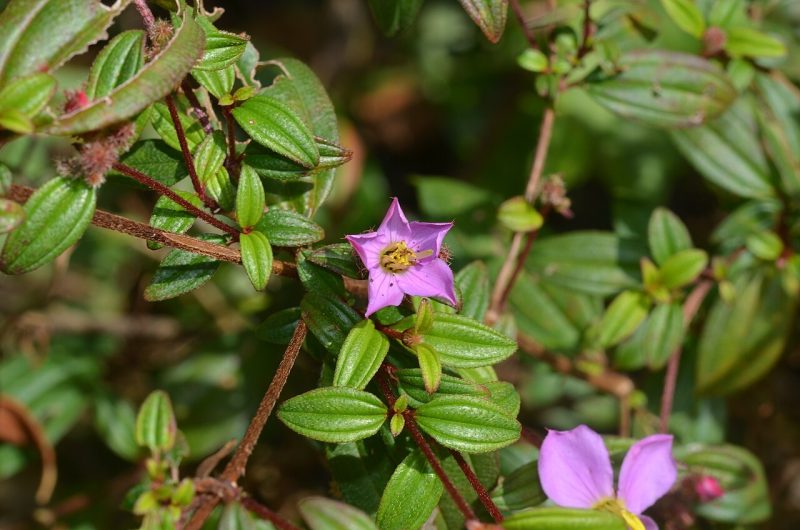
Heen bovitiya (Osbeckia octandra) is a plant with an unusually specific reputation. Where many herbs are described as good for a long list of complaints, this one is associated in Sri Lankan traditional medicine with a single organ: the liver.
Botanical and Cultural Background
A shrub of the Melastomataceae family, heen bovitiya grows to a metre or two, with characteristic leaves showing the family's distinctive parallel longitudinal veins, and small purple-pink flowers. It favours the wet zone and hill country, appearing along stream banks, roadside verges and disturbed ground.
The plant occupies a specific niche in local practice: leaf juice given for jaundice and for what traditional medicine describes as liver-related complaints. It is one of a small group of Sri Lankan herbs — alongside heen pitawakka and bim kohomba — reached for in this context.
Traditional Uses in Sri Lankan Medicine
Liver complaints and jaundice
The defining use. Fresh leaf juice or a decoction is traditionally given where the eyes and skin have yellowed, and in conditions understood as heat or obstruction affecting the liver.
Hepatitis
Traditional practitioners have used heen bovitiya in the management of hepatitis, typically as part of a broader regimen including dietary restriction.
As a leafy green
The tender leaves are eaten as a mallum in some households, a gentle everyday form of the plant.
What the Research Shows
Heen bovitiya is a case where Sri Lankan science has taken a local remedy seriously. Researchers at Sri Lankan universities have investigated Osbeckia octandra for hepatoprotective activity, reporting protective effects against chemically induced liver injury in animal models — work associated with Thabrew and colleagues, among others. Constituents reported include flavonoids and related phenolic compounds.
This is a genuinely interesting body of preclinical evidence, and more locally grounded than for many herbs on this site. It remains preclinical. It does not establish that heen bovitiya treats hepatitis or any liver disease in people, and no one should read it that way.
How Heen Bovitiya Is Prepared
Leaf juice: Fresh leaves are pounded and the juice expressed, traditionally taken in small measured quantities.
Decoction: Leaves boiled in water and strained.
Mallum: Tender leaves shredded and lightly cooked with coconut.
Safety and Precautions
Liver disease is the reason to be careful here, not the plant. Jaundice is a symptom, not a diagnosis — it can arise from viral hepatitis, gallstones, drug toxicity, alcohol, or cancer, and these differ completely in urgency and treatment. Yellowing of the eyes or skin needs prompt medical assessment and blood tests. Treating it at home with leaf juice, without knowing the cause, risks allowing something serious to progress.
There is a further irony worth stating plainly: herbal preparations are themselves a recognised cause of liver injury worldwide, and a damaged liver is less able to process what you give it. If your liver is unwell, every substance you take — herbal included — should be known to your doctor.
Heen bovitiya is not recommended in medicinal quantities during pregnancy without professional advice. Correct identification matters, as several Osbeckia species and the larger maha bovitiya are similar in appearance.


Comments (0)
Leave a Comment