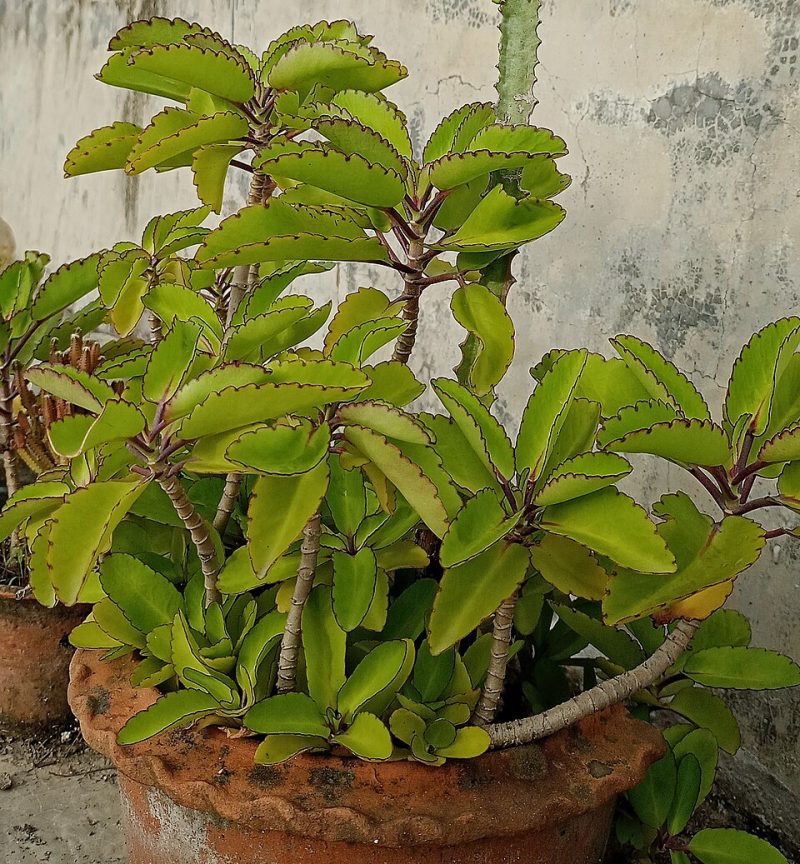
Akkapana (Kalanchoe pinnata) earns its English names — Life Plant, Miracle Leaf — honestly enough: drop a detached leaf on soil and plantlets sprout from every notch along its edge. In Sri Lanka it is the plant people chew for kidney stones. It also contains compounds that act on the heart, which is a fact worth carrying alongside the enthusiasm.
Botanical and Cultural Background
Akkapana is a succulent of the Crassulaceae family, native to Madagascar and thoroughly naturalised here, with thick fleshy scalloped leaves and pendulous bell-shaped flowers. Its vegetative reproduction from leaf margins is what made it an ornamental curiosity and gave it its names.
Traditional Uses in Sri Lankan Medicine
Kidney and bladder stones
Its most famous local use — fresh leaves chewed on an empty stomach, or the juice taken daily.
Wounds and boils
A leaf warmed over a flame, crushed and bound over a cut, burn or boil. This external use is the plant's most defensible one.
Insect bites
Crushed leaf applied to stings and bites.
Gastritis
Leaf juice taken traditionally for acidity.
What the Research Shows
Research on Kalanchoe pinnata reports anti-inflammatory, antimicrobial, wound-healing and hepatoprotective activity in laboratory and animal models, and has identified flavonoids, phenols and — importantly — bufadienolides.
Those bufadienolides are cardiac glycosides. They act on the heart in the same manner as digoxin, and they are the reason Kalanchoe species cause fatal poisoning in grazing livestock in southern Africa, where the syndrome is well documented. In humans the risk from a few leaves is low — Sri Lankans have chewed akkapana for generations — but "low from a few leaves" is not "harmless in any quantity", and this plant does not deserve to be treated as a salad.
On stones specifically, human clinical evidence is absent. Laboratory work on antiurolithiatic activity exists; the confident claim that akkapana dissolves calcium oxalate stones so they "pass painlessly" is not supported.
How Akkapana Is Prepared
For stones (traditional): Two or three washed fresh leaves chewed in the morning.
Wound poultice: A leaf softened over a flame, crushed and bound over the wound.
Safety and Precautions
Never put akkapana juice — or any plant juice — into an ear or an eye. This is the clearest correction on this page, because tradition recommends both. The eye is delicate and unforgiving: non-sterile plant material can cause corneal injury and introduce infection, and conjunctivitis and styes have safe, effective treatments. If the eardrum is perforated, and you cannot know whether it is, liquid in the middle ear can cause lasting damage and hearing loss. Eye and ear symptoms need a doctor.
Do not consume akkapana in large amounts or for long periods. It contains cardiac glycosides. Traditional use — a few leaves — has a long record, but prolonged or heavy consumption is genuinely unwise, and anyone with a heart condition or taking digoxin, beta-blockers or other cardiac medication should not take it internally at all without medical advice. Do not take it in pregnancy or while breastfeeding, and do not give it to children.
Kidney stones need imaging. A stone large enough to matter will not be chewed away, and it can obstruct the kidney. Severe pain, fever with urinary symptoms, or blood in the urine means go to hospital. Because akkapana acts as a diuretic, do not combine it with prescription diuretics without supervision.



Comments (0)
Leave a Comment